Key takeaways
- When Do You Need an Extension Downrod. Use an extension when the ceiling is higher than the downrod that came with the fan can reach.
- What Does a Wire Extension Kit Do. A wire extension kit carries power from the ceiling box through the longer downrod to the fan.
- How Do You Choose the Right Length. Measure from the ceiling to the height you want the blades, then choose the closest length, not the longest.
- What Should You Check Before Installing. Turn the power off at the breaker, confirm the outlet box can support the fan, and check each connection.
When Do You Need an Extension Downrod?
Use an extension when the ceiling is higher than the downrod that came with the fan can reach.
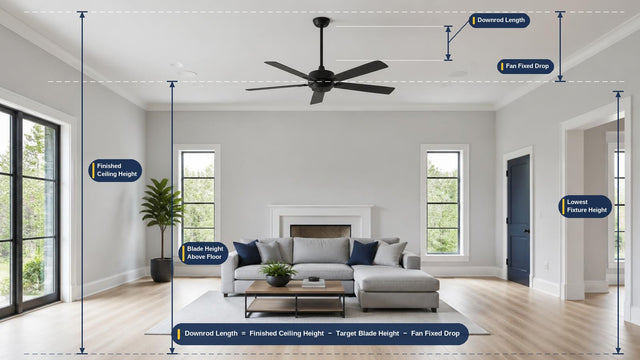
A fan on a downrod hangs at a height set by the downrod length. If the ceiling is taller than the standard downrod allows, the blades can sit higher than you want and the fan can look lost. An extension downrod adds length so the blades sit at the right height. The number you need depends on the ceiling height and the blade clearance in your manual. Our downrod length calculator walks through the math.
Manuals in our product files list a minimum blade clearance of 7 feet (2.1 meters) for some models and 7.5 feet (2.3 meters) for others. That minimum is the first number to check.
What Does a Wire Extension Kit Do?
A wire extension kit carries power from the ceiling box through the longer downrod to the fan.
The wires inside a downrod are sized for the length that came with the fan. A longer downrod needs longer wires, so a wire extension kit adds the extra length. Kits usually contain wires, connectors and sometimes a matching canopy or coupling. Do not stretch the factory wires, and do not join them with loose twist nuts inside the downrod.
Wiring details differ between models. Follow the wiring diagram in the manual for your fan, and have a licensed electrician do any work inside the ceiling box.

How Do You Choose the Right Length?
Measure from the ceiling to the height you want the blades, then choose the closest length, not the longest.
Start with the ceiling height. Subtract the blade height you want from the ceiling height, then pick the downrod that brings the blades to that point. If you are between two lengths, choose the shorter one if the blades would otherwise sit too close to a door or a person who is tall. Keep the fan centered in the room, and check that the blades stay clear of the walls.
Check first: a longer downrod moves the fan lower. Confirm the blade height before you order the extension, not after.
What Should You Check Before Installing?
Turn the power off at the breaker, confirm the outlet box can support the fan, and check each connection.
Before you install an extension, check the outlet box rating. Ceiling fans need a box rated for fan support, and a standard light box is not enough. Keep the canopy snug against the ceiling, tighten the downrod setscrews, and check that the wires do not pinch. After installation, run the fan on each speed and watch for wobble or noise. A new wobble often means the downrod or a blade bracket is not fully tightened.
For a step-by-step installation, see how to install a ceiling fan with light.
Is an Extension Better Than a Longer Downrod?
Choose the option that matches the fan. An extension is only useful when the fan supports it.
An extension downrod and a longer downrod can look similar, but the fan must be designed to take the extension. Some fans come with a set of downrods and can be used at several lengths. Others have one fixed length and need a matching extension from the manufacturer. Read the manual for the list of approved lengths before buying anything separately.
Do not join two downrods with a coupler unless the manual shows that method. A coupler that is not rated for the fan can loosen over time and cause wobble.
What Are the Signs the Downrod Is Wrong?
Wobble, noise and a fan that hangs at an angle often point to a mounting or downrod problem.
A downrod that is too long for the mount can make the fan sway. A fan that hangs at an angle may have a loose setscrew or a downrod that is not seated in the bracket. Check the canopy, the ball joint and the setscrews each time you install an extension. If the fan still wobbles after tightening, the blade balance may be the cause, and the balancing guide walks through that check.
For the balancing steps, see how to balance a wobbling ceiling fan.
Does an Extension Affect the Warranty?
Use approved parts only, because a non-approved extension can affect the fan and the warranty.
Breezary warranty terms cover the motor, fan parts and light parts when the product is installed as directed. Installing a non-approved extension may not be covered, so ask customer service before you buy a part from another source.
How Do You Match the Length to a Tall Ceiling?
Measure the ceiling height twice, then add the extension only as far as the blade height requires.
For a ceiling above about 10 feet, the combined downrod length can get long fast. A longer downrod gives more wobble if it is not braced, so keep the extension to the length the fan needs. Measure from the ceiling to the height you want the blades, not to the floor, and round down rather than up. If the calculator shows two options, choose the shorter one for a steadier fan.
For the steps to measure and check the blade height, see the length section of our downrod length calculator.
How Do You Keep the Extension Wiring Safe?
Keep the wires separate, protected and free of strain at both ends.
The wires in a downrod must not be stretched, kinked or pinched. Feed them through the downrod without twisting, and leave a small loop at the canopy so the fan can move slightly without pulling on the connections. Use connectors rated for the wire size, and check that each connection is tight. Turn the power off before opening the canopy, and confirm it is off with a tester.
Check first: if you are not sure which wire is which, stop and call a licensed electrician.
Ceiling Fan Extension Downrods and Wire Extension Kits FAQ
Do I need an extension downrod for a 10-foot ceiling?
It depends on the fan and the blade height you want. Use the calculator and the manual minimum to decide, since downrod lengths vary by model.
Can I use any extension downrod with my fan?
No. Check that the extension matches the fan and the mount type, and that the wire kit is compatible with the wiring in the downrod.
Is a wire extension kit the same as a downrod?
No. The downrod is the metal tube that holds the fan. The wire extension kit carries power through a longer tube.
Do I need an electrician to install an extension?
Often yes, especially if the outlet box must be replaced or the wiring is unfamiliar. Turn the power off at the breaker before any work.
Can I install an extension myself?
Only if you are comfortable working inside a ceiling box with the power off. Otherwise, use a licensed electrician.
Browse the related collections.
View downrod ceiling fans with lights