
Key takeaways
- Bunk beds are the main risk. US studies link many child fan injuries to bunk beds, loft beds and being lifted toward the fan.
- Measure from the top bunk. The manual's minimum is to the floor; also check the mattress, ladder and bed edge against the blade path.
- Enclosed is not certified. Cages and frames reduce exposed blades, but no Breezary page claims a child-safety certification.
- Keep control with adults. Use timers, low dimmed light and a child-lock remote where the model offers one.
Is a Ceiling Fan Safe in a Kids' Room?
It can be, when the fan meets the manual's minimum blade height and no bed, ladder or climbable furniture puts a child's head near the blades. The real risk in kids' rooms comes from bunk beds, loft beds and children being lifted toward the fan, not from the fan running on its own.
That is what US injury data shows. A 2023 research letter in Pediatrics, the journal of the American Academy of Pediatrics, estimated that about 2,300 children a year were treated in US emergency departments for head injuries from ceiling fans between 2013 and 2021. The authors, from Dell Children's Trauma and Injury Research Center, described two common patterns: young children being lifted or tossed up by an adult, and older children on bunk beds, loft beds or furniture.
A follow-up study from the same team, published in Pediatric Neurosurgery in 2024, reviewed 60 children treated at one pediatric trauma center. Nearly half of those injuries (47%) involved bunk or loft beds, and 18% involved a child being lifted by a caregiver. Most were minor cuts, but some were skull fractures.
So the useful question for a kids' room is not "which fan is safe" but "where are the bed, the ladder and the blades in relation to each other".
Can You Put a Ceiling Fan Over a Bunk Bed or Loft Bed?
Avoid it. A fan that meets its floor-height minimum can still be within reach of a child sitting, kneeling or standing on a top bunk or loft bed.
Fan manuals give one height rule: the minimum distance from the trailing edge of the blades to the floor. That number assumes people are standing on the floor. A top bunk raises a child's head by the height of the bed frame, and a ladder lets them climb higher still. The manual does not give a separate bunk-bed number, and we won't invent one.
The published guidance we could verify is about distance and age:
- ACCC (Australia, 2013): "Place bunk beds and other furniture 2 metres away from ceiling fans" (about 6.5 feet), and "Do not lift children when underneath or near a ceiling fan."
- Product Safety Australia, bunk beds guide: keep the bunk bed clear of blind and curtain cords, heaters, lights and ceiling fans, and the top bunk or a raised bed isn't recommended for children under 9.
- US Consumer Product Safety Commission: urges parents not to put children under the age of 6 on the top bunk.
If the room is too small to keep the top bunk away from the blade path, the safer options are to move the bed, move the fan, or skip a ceiling fan in that spot.
How Do You Measure Bunk Bed Clearance From a Ceiling Fan?
Measure from where the child will be, not from the floor: the top-bunk mattress, the top of the ladder, and the edge of the bed nearest the blade path.
- Find the blade path. With the fan off, note the lowest point of the blades and how far the tips reach out from the center. For enclosed fans, use the outer frame.
- Measure up from the top mattress. Then picture a child sitting or kneeling on it, because that is how bunks are used.
- Check the ladder. The top rungs are where children stand and turn.
- Check sideways. Measure from the bed edge to the nearest blade tip, then compare with the ACCC's 2-metre advice above.
- Confirm the floor minimum. Read the minimum blade-to-floor height in the manual for your exact model.
Installed height matters too. A flush-mount fan keeps the blades closer to the ceiling than a downrod fan of the same size; our comparison of flush mount and standard ceiling fans explains the trade-offs for lower ceilings.
Open-Blade vs Enclosed or Caged Fans for a Kids' Room
An enclosed or caged fan keeps the blades inside a frame, which reduces exposed blade edges. It is still not a safety rating, and it doesn't replace keeping beds and climbing furniture away.
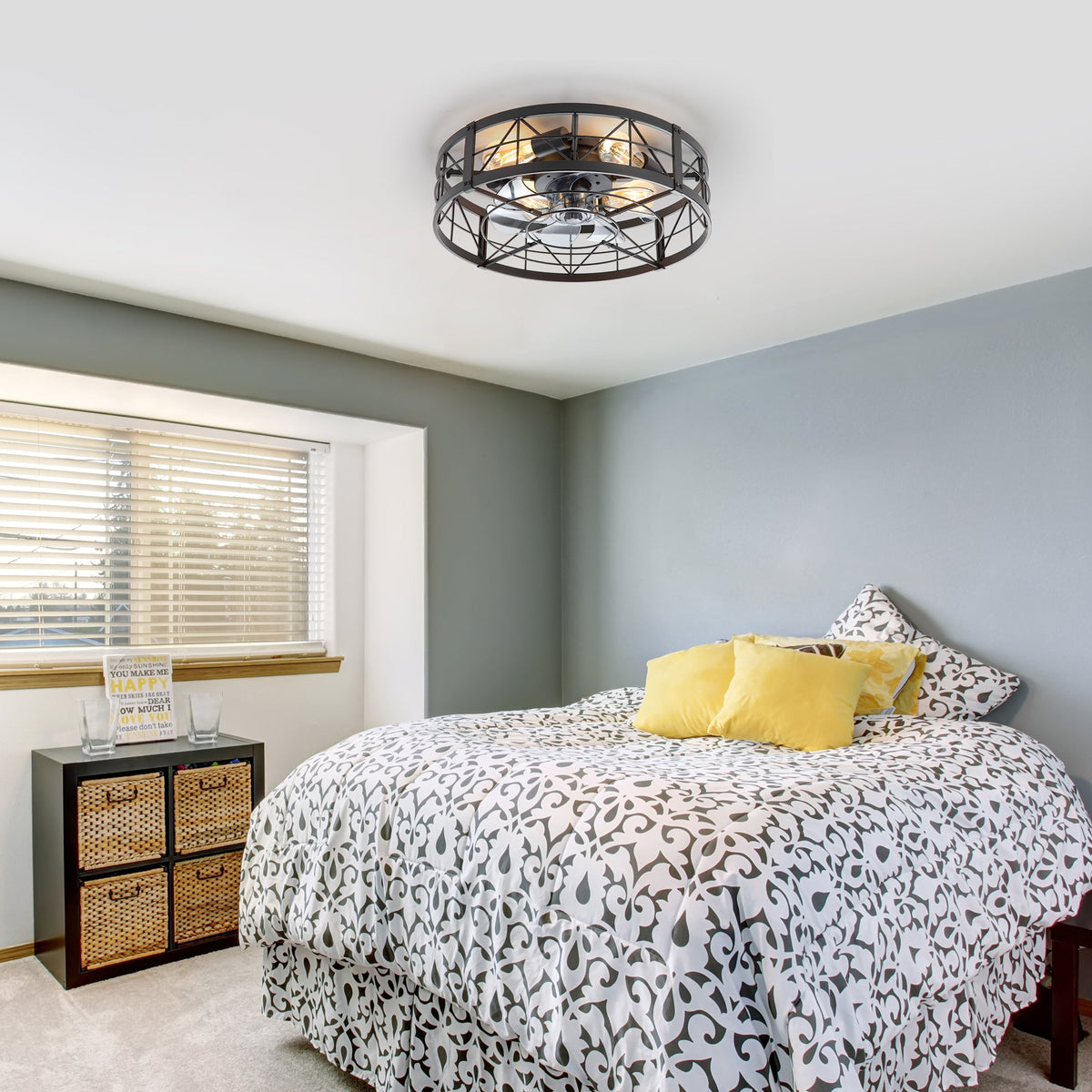
Breezary's children's ceiling fans are mostly small enclosed, caged and low-profile designs. None of their product pages lists a child-safety certification, so we don't call any of them "child-safe". Here are real models with the details their pages publish:
| Model | Blade design | Size and installed height | Minimum blade height on the product page | Remote features noted |
|---|---|---|---|---|
| Ravora 16.5-Inch Small Caged | Inside a metal cage | 16.5 in wide, 8 in high, flush mount | At least 7.5 ft, plus at least 18 in from walls | 1H, 2H, 4H, 8H timers |
| Brielle 20" Flush Mount Caged | Inside a geometric cage | 20 in wide, flush mount | Not stated; see the 35002 manual | 1H, 2H, 4H, 8H timers |
| Mistrara 20-Inch Flush Mount | Inside a round light frame | 20 in, 6.29 in high, flush mount | At least 7 ft | 2-hour timer, dimmable light |
| Delvessa 24-Inch Low Profile | Inside a circular frame | 24 in, about 7 in high, flush mount | At least 7.5 ft | 2-hour timer, dimmable light |
| Elvoria 32" Black Enclosed | Inside a circular frame | 32 in, about 7 in high, flush mount | Not stated; see the 41008 manual | Child lock, 10%–100% dimming |
| Covara 36-Inch 3-Blade | Open blades | 36 in, about 12.2 in high with the 5-in downrod | Not stated; see the 30041 manual | 1H and 4H timers |
A frame still has openings. Keep fingers, toys and sticks out of them, and never let a child use the fixture as a handhold. For how air moves through these designs, see how enclosed ceiling fans work; for the style differences between caged, enclosed and standard fans, see fandelier vs ceiling fan.
Is a Smaller Ceiling Fan Automatically Safer?
No. A smaller fan has a shorter blade path, but it is placed by the same rules, and small fans often spin faster than large ones.
The Ravora lists a maximum of 900 RPM and the Mistrara 800 RPM, while the larger Elvoria lists 160–280 RPM. Speed is only one factor, but it is a good reason not to treat "small" as a safety feature. The Covara 36-Inch 3-Blade Ceiling Fan is a common size for kids' rooms; its product page suggests rooms of about 10 × 10 to 12 × 12 feet. With open blades, its whole blade circle needs to stay clear of the top bunk and ladder.
Choose the size for the room first, using our guide on what size ceiling fan you need, then check placement against the bed.
How Should You Use Remotes, Timers and Night Lights in a Kids' Room?
Keep the remote with an adult, use a timer so the fan shuts off on its own, and use a low dimmed setting rather than a bright light at night.
- Child lock: the Elvoria remote's child-lock button locks the controls when held for about five seconds.
- Timers: Brielle offers 1-, 2-, 4- and 8-hour shutoff; Mistrara and Delvessa list a 2-hour timer.
- Dimming: Elvoria dims from about 10% to 100%; Mistrara and Delvessa also list dimmable light.
- Wall controls: follow the manual. Ravora's page says not to use a dimmer or solid-state wall speed control.
Check first: a remote left on a top bunk invites a child to stand up and point it at the fan. Store it out of reach.
When Should You Move the Fan or Skip It?
Move the bed or the fan when a top bunk, loft bed or ladder sits under or beside the blade path, or when the room can't meet the manual's minimum height.
- The top bunk or loft bed can't be placed away from the fan.
- A child stands, plays or jumps on the top bunk.
- Adults in the home tend to lift small children overhead in that room.
- The ceiling is too low to meet the manual's blade-to-floor minimum.
Moving a fan means a new fan-rated box and wiring work. Our guide on replacing a light fixture with a ceiling fan covers the box, and the electrical work belongs with a licensed electrician.
Comparing small enclosed and caged fans?
View Children's Ceiling FansKids' Room Ceiling Fan FAQ
Can you put a ceiling fan over a bunk bed?
It is better not to. Bunk and loft beds put a child's head much closer to the blades than the floor-based minimum in the manual assumes. Australia's ACCC advises placing bunk beds and other furniture 2 metres away from ceiling fans. Move the bed, move the fan with an electrician's help, or leave that spot without a ceiling fan.
Is a 36-inch ceiling fan with light safe for a room with bunk beds?
Size alone does not make a fan safe or unsafe. A 36-inch open-blade fan such as the Covara still sweeps a full circle of blades, so the question is where the top bunk and ladder sit relative to that circle. Keep the bed clear of the blade path and meet the manual's minimum blade height.
Are enclosed ceiling fans safe for kids?
An enclosed or caged design keeps the blades inside a frame, which reduces exposed blade edges, but it is a design feature, not a child-safety certification. No Breezary product page lists a child-safety certification. Keep fingers and toys out of the openings and still keep beds and climbing furniture away from the fan.
What is the minimum height for a ceiling fan in a child's room?
Use the minimum printed in your fan's manual, measured from the trailing edge of the blades to the floor. Breezary product pages list at least 7 feet for some models, such as Mistrara, and at least 7.5 feet for others, such as Ravora and Delvessa. That is a floor measurement and does not account for a bunk or loft bed.
How old should a child be to sleep on the top bunk?
The US Consumer Product Safety Commission urges parents not to put children under 6 on the top bunk. Australia's Product Safety guide does not recommend the top bunk or a raised bed for children under 9.
Is there a ceiling fan remote with a child lock?
Yes, on some models. The Elvoria 32" Black Enclosed Ceiling Fan remote has a child-lock button that locks or unlocks the controls when held for about five seconds. Check each product page, because most remotes do not list this feature.


