Key takeaways
- A fandelier is lighting first. It looks like a chandelier and moves air with a small blade set, so it suits small to medium rooms.
- Caged and enclosed overlap. A cage is an open frame; enclosed means the blades sit inside it. Many models, like the Calivra crystal fan, are both.
- Width is not blade span. A 28-inch enclosed fixture can have a listed blade size of 17.7 inches, while a 52-inch open fan uses its full width.
- For big rooms, go full size. A 52-inch fan with a crystal or caged light kit keeps the chandelier look and covers more floor.
What Is the Difference Between a Fandelier and a Ceiling Fan?
A fandelier is designed to be seen as a light fixture first and a fan second. A standard ceiling fan is designed around its blade span, with the light added below the motor.
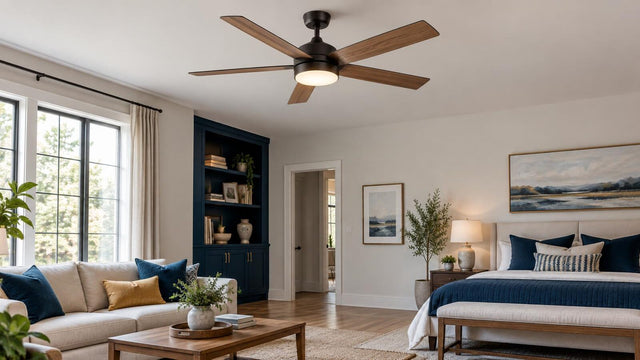
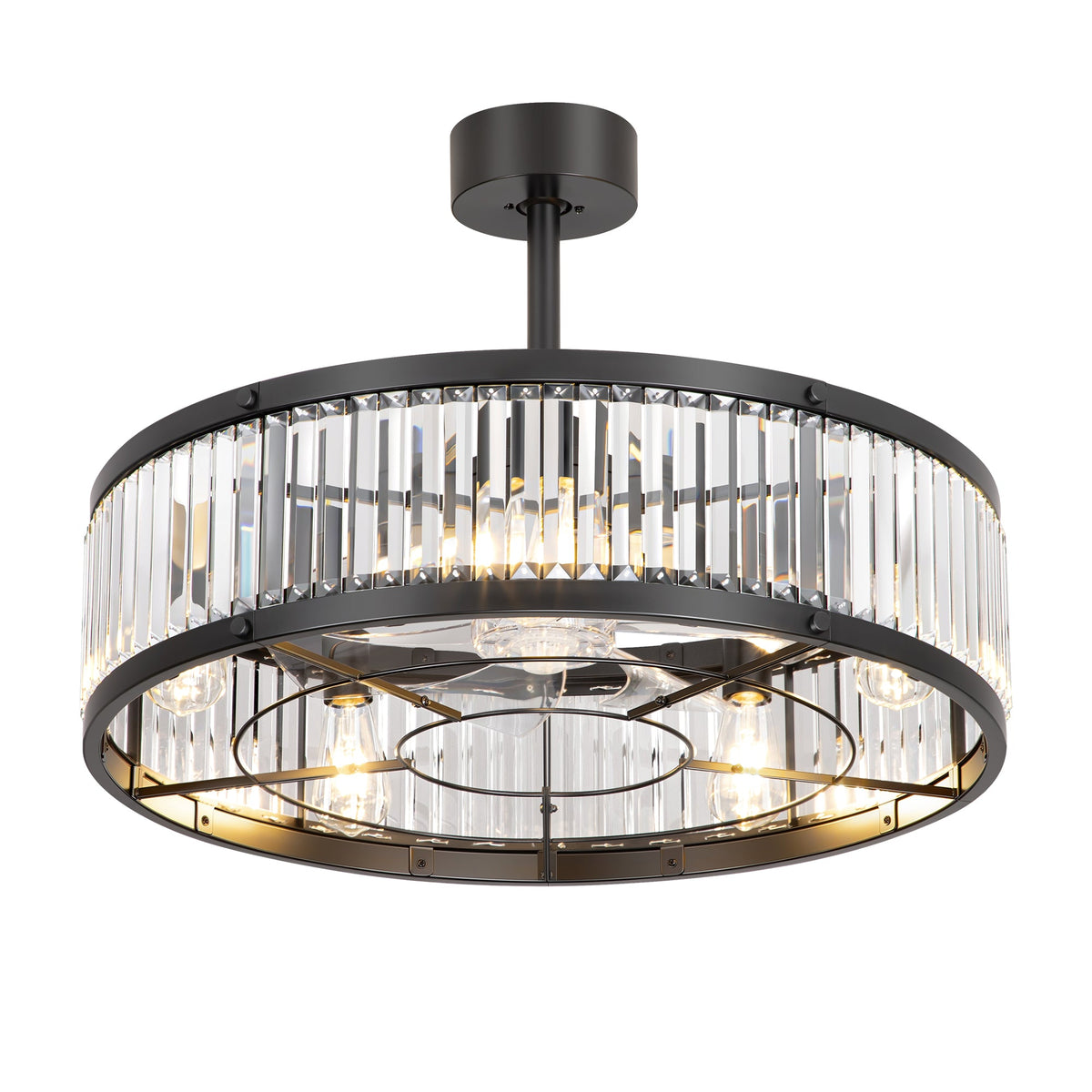
The difference shows up clearly in the specs. The Velmora 52-Inch 5-Blade Ceiling Fan With Light & Remote is a standard fan: five plywood blades across a 52-inch span, a 24W integrated LED under the housing, and a listed room fit of medium to large rooms up to 350 sq. ft. The Calivra 28-Inch Crystal Chandelier Ceiling Fan With Light is a fandelier: a 28-inch black iron drum with crystal accents, five E26 bulb sockets, and seven transparent ABS blades that the product description says are "enclosed within the fixture." Its listed room fit is small to medium rooms up to 175 sq. ft.
Neither is better in general. A fandelier wins when the ceiling needs a decorative focal point and the room is small. A standard fan wins when you need air across a larger space. Many homes end up in the middle: a full-size fan with a chandelier-style or caged light kit underneath.
Caged vs Enclosed Ceiling Fan: Are They the Same?
Not exactly, and they are not opposites either. "Caged" means an open frame of bars or rings you can see through; "enclosed" means the blades sit inside a drum, shade or weave. Plenty of fans are both.
Product names are not a reliable guide, so look at what the frame actually surrounds:
- Cage around the light only. The Cavora 52-Inch Industrial Caged Ceiling Fan With Light has an open iron cage holding three E12 bulbs, but its five reversible plywood blades are fully exposed across a 52-inch blade span. Its own description calls it a downrod-mounted open-blade fan.
- Cage around the blades. The Tavon 28-Inch Black Caged Ceiling Fan With Lights uses an open metal cage that frames three black-and-walnut MDF blades and four exposed E12 sockets.
- Caged and enclosed at once. The Calivra crystal model is listed as both "Chandelier" and "Cage" fan types, and its blades are enclosed within the drum.
- "Enclosed" in the name, blades visible. The Elvoria 32" Black Enclosed Ceiling Fan With Light & Remote wraps its LED around an outer ring, and its three black blades stay visible in the center.
Retractable-blade fans, which fold their blades away when off, are a separate design. Breezary's current catalog does not include one, so don't treat "retractable" as another word for enclosed when you compare listings.
How Do Real Caged, Enclosed and Standard Models Compare?
Open-blade fans in this comparison are 52 inches wide and listed for rooms up to 350 sq. ft. The caged and enclosed fandeliers are 16.5 to 28 inches wide and listed for rooms up to 175 sq. ft.
| Model | Listed fan type | Width | Blades | Where the blades sit | Listed room fit |
|---|---|---|---|---|---|
| Velmora 52-Inch 5-Blade | Standard | 52 in | 5 plywood | Open, light below the housing | Up to 350 sq. ft. |
| Cavora 52-Inch Industrial Caged | Chandelier, Standard | 52 in | 5 reversible plywood | Open; the cage holds the bulbs | Up to 350 sq. ft. |
| Iverelle 52-Inch 5-Blade Crystal | Standard, Chandelier | 52 in | 5 ABS | Open; crystal-and-iron fixture below | Up to 350 sq. ft. |
| Tavon 28-Inch Black Caged | Chandelier, Cage | 28 in | 3 MDF | Inside an open metal cage | Up to 175 sq. ft. |
| Calivra 28-Inch Crystal Chandelier | Chandelier, Cage | 28 in | 7 transparent ABS | Enclosed in an iron drum | Up to 175 sq. ft. |
| Ravora 16.5-Inch Small Caged | Standard, Flush Mount | 16.5 in | 7 ABS | Inside a round black cage | Up to 175 sq. ft. |

Is a Fandelier's Width the Same as Its Blade Span?
No. On an enclosed fandelier the listed width is the outside of the fixture, and the blades turning inside are noticeably smaller.
The Calivra crystal model is 28 inches across, but its listed blade size is 17.7 x 17.7 inches. The Brielle 20" Flush Mount Caged Ceiling Fan With Light & Remote is 20 inches wide with a listed blade size of 12.59 x 12.59 inches. On an open-blade fan such as the Cavora 52-inch, the width and the blade span are the same number.
So a 28-inch fandelier is not a slightly smaller 52-inch fan. It moves air through a much smaller blade set, and that changes how the breeze feels. We explain the mechanics, including the intake and outlet path, in how enclosed ceiling fans work. If you want to compare listed airflow numbers between models, use our ceiling fan CFM guide.
Check first: on any fandelier listing, look for "blade size" next to the overall width. If only the width is given, ask customer service for the blade dimensions before you compare it with a standard fan.
Should You Choose a Fandelier for Looks or a Ceiling Fan for Airflow?
Decide which job matters more in that room. If the fixture has to look like a light first, choose a fandelier. If the room has to feel cooler from wall to wall, choose a full-size fan and pick a decorative light kit.
A fandelier or enclosed fan makes sense when
- The room is small to medium, such as a bedroom, breakfast nook, walk-in closet or home office.
- You want the fixture to read as lighting. Ravora's description puts it plainly: the fan "looks more like a fixture than an appliance."
- The ceiling is low and you need a flush profile. Ravora is 8 inches tall, Brielle 7 inches.
- You mostly want a gentle, local breeze over a bed, desk or small table.
A standard fan with a decorative light makes sense when
- The room is larger, or you want air moving across a seating area and not just under the fixture.
- You still want the chandelier look. The Iverelle 52-inch pairs five silver blades with a crystal-and-iron light, and the Jorelle 52-Inch Farmhouse Caged Ceiling Fan With Light & Remote frames its light in a matte-black cage.
For a wider look at which fans suit which rooms, our best ceiling fans with lights guide gives short picks by room.
How Do You Pair a Fandelier With Pendants and Other Chandeliers?
Let one fixture lead, keep a small ceiling from getting crowded, and match the finish family rather than buying the same style for every light.
Open kitchens and dining areas often put island pendants, a fandelier over the table and recessed lights in one sightline. A few rules keep that from looking busy:
- Pick one lead fixture. A crystal fandelier like the Cinderra 28-Inch Crystal Caged Ceiling Fan With Lights already draws the eye, so simple pendants let it lead. If the island pendants are the showpiece, choose a plainer caged or drum fan.
- Count the fixtures in a small room. Two pendants plus a fandelier can crowd a small kitchen ceiling. If they read as one cluster from the doorway, use fewer pendants or let recessed lights handle the general lighting.
- Match the finish, not the model. Fixtures don't need to come from one collection. Keeping the metals in one family, such as all matte black or all warm gold, ties them together. Our guide to ceiling fan finishes explains how brass, nickel and chrome sit together.
- Give each fixture its own spot. Center the fandelier over the table and the pendants over the island, and follow the fan manual's minimum clearances, including blade height above the floor.
- Match the light color. In socket models like the Calivra crystal, use bulbs with the same color temperature as the pendants. Integrated models list their range; the Halcyra 20-Inch Boho Rattan is listed at 2700K-3000K.
- Plan the controls. Pendants are often on a wall dimmer, but several caged models, including the Cinderra and Ravora, say not to use one. Expect to adjust the fandelier from its remote.
Can a Fandelier Replace a Dining Room Chandelier?
Yes, if the dining area is small to medium and you mostly want light over the table with a mild breeze. In a large or open dining space, a 52-inch fan with a chandelier-style light usually fits the room better.
Several compact models list dining areas among their intended rooms, including the Cinderra 28-Inch Crystal Caged Ceiling Fan With Lights, the Tavon and the Halcyra 20-Inch Boho Rattan Ceiling Fan With Light. A few practical points before you swap:
- Light output depends on the model. Socket models need bulbs you buy separately. The Calivra crystal takes five E26 bulbs at 10W maximum each. Integrated models like the Halcyra Boho dim from the remote instead.
- Dimmers. Several caged models say not to use a wall dimmer or variable wall control, including the Ravora and the Cinderra. Plan on remote control.
- Mounting. A fan needs a fan-rated box, unlike many chandeliers. Our guide to replacing a light fixture with a ceiling fan covers what to check before installation. Follow the product manual, and hire a qualified electrician if you are unsure about the wiring or the box.
- Upkeep. Crystals and cages collect dust in more places than a plain fan. See how to clean enclosed and caged ceiling fans before you choose a design with a lot of detail.
Want the chandelier look with a built-in fan?
View Chandelier Ceiling FansFandelier vs Ceiling Fan FAQ
Is a fandelier the same as a chandelier ceiling fan?
The terms are used loosely and often mean the same thing: a ceiling fan styled like a chandelier. Some are compact fixtures with enclosed blades, like the Calivra 28-Inch Crystal Chandelier Ceiling Fan, while others are full 52-inch fans with a chandelier-style light kit below, like the Iverelle 52-Inch 5-Blade Crystal Ceiling Fan.
Do caged ceiling fans move less air than regular ceiling fans?
It depends on what the cage surrounds. If the cage only holds the bulbs, as on the Cavora 52-Inch Industrial Caged fan, the blade span is a full 52 inches. If the blades sit inside a small cage or drum, the blade set is much smaller than a standard fan, and the listed room fit drops to small and medium rooms.
What is the difference between caged and enclosed ceiling fans?
A caged fan has an open frame of bars or rings you can see through. An enclosed fan has its blades inside a drum, shade or weave. The terms overlap, so check the product photos and the blade description rather than relying on the name.
Are enclosed ceiling fans a good choice for a bedroom?
For a small or medium bedroom where you want a decorative light and a gentle breeze, yes. The compact enclosed models in our catalog list room fits up to 175 sq. ft. Always follow the minimum blade height in the manual; Ravora, for example, asks for at least 7.5 feet above the floor.
Can I put a fandelier on a dimmer switch?
Usually not on a wall dimmer. Several caged and crystal models, including Ravora and the Cinderra 28-Inch Crystal Caged fan, say not to use a dimmer or variable wall control. Models with integrated LEDs, such as the Halcyra 20-Inch Boho Rattan fan, dim from the included remote instead.