Key takeaways
- Antique, vintage and retro are not the same. Antique means about 100 years or older, vintage means decades old, and retro means new with an older look.
- Brass color does not prove age. New fans get gold tones from paint, plating or lacquer; age is shown by maker labels, construction and history.
- The vintage look lives mostly in the light. Tiffany-style glass, seeded glass, schoolhouse globes and decorative cages do most of the work.
- Have an old fan inspected before use. A qualified electrician should check any genuinely old fan; for daily use, a retro reproduction is simpler.
What Is the Difference Between Vintage, Antique and Retro Ceiling Fans?
An antique ceiling fan is genuinely old, usually around 100 years or more. A vintage fan is an older fan, typically a few decades old. A retro fan is a new fan made to look like an earlier era.
The three words get used as if they meant the same thing, especially in store listings. The difference matters because you are buying very different things. An antique is a collectible object with an electrical history you cannot see. A vintage fan is a used fan from a past decade. A retro fan is a new product with current parts, a warranty and a look borrowed from the past.
When a shop sells "vintage ceiling fans," it almost always means vintage-style fans. That is true of Breezary's own vintage range: these are new fans with modern motors, remotes and standard bulb sockets.
| Term | What it usually means | What you are buying | What to ask |
|---|---|---|---|
| Antique | About 100 years old or more | An original old fan, often a collector piece | Who made it, when, and has it been inspected? |
| Vintage | Decades old, with no fixed cutoff | A used fan from an earlier period | What condition are the motor, wiring and mount in? |
| Retro or vintage-style | New, with an older look | A current fan with modern parts | What are the specs, bulb limits and warranty? |
How Can You Tell If a Ceiling Fan Is Really Antique?
You prove age with evidence about who made the fan and when, not with its color or its worn look.
Electric ceiling fans have been made since the late 1800s, so a true antique would date from roughly the 1920s or earlier. The useful evidence is the kind a collector or appraiser would ask for:
- A maker's plate or label with a company name, model or patent information that can be looked up.
- Construction that fits the period, such as heavy cast-metal housings and hardware made before plastics were common.
- Documented history, like a sale record, a house it came from or a restorer's notes.
- No modern giveaways, such as a handheld remote, a DC motor label or a current safety certification sticker.
None of these is proof on its own. Old-looking parts are reproduced, and labels can be added later. If the value of a fan matters to you, ask a specialist appraiser rather than relying on a listing description.
Why Brass Color Does Not Prove a Fan Is Antique
A warm brass or gold color says nothing about age. New fans get that color from paint, plating or lacquer over other metals, and many early fans were painted black or other colors in the first place. Distressing can also be built in from the factory. Breezary's Roson fan, for example, is new but describes its floral cage as an aged white finish with touches of golden paint. If you want to identify the finish itself, see how to tell brass, bronze, nickel and chrome finishes apart.
Check first: If you own a genuinely old fan, do not plug it in or wire it up to test it. Have a qualified electrician inspect it first. This guide does not cover repairing or rewiring antique electrics.
What Makes a New Ceiling Fan Look Vintage?
Most of the vintage look comes from the light: the glass or shade, the cage around it, and the finish. The blade shape matters less than people expect.
These are the style cues to look for, and the eras people usually connect them with:
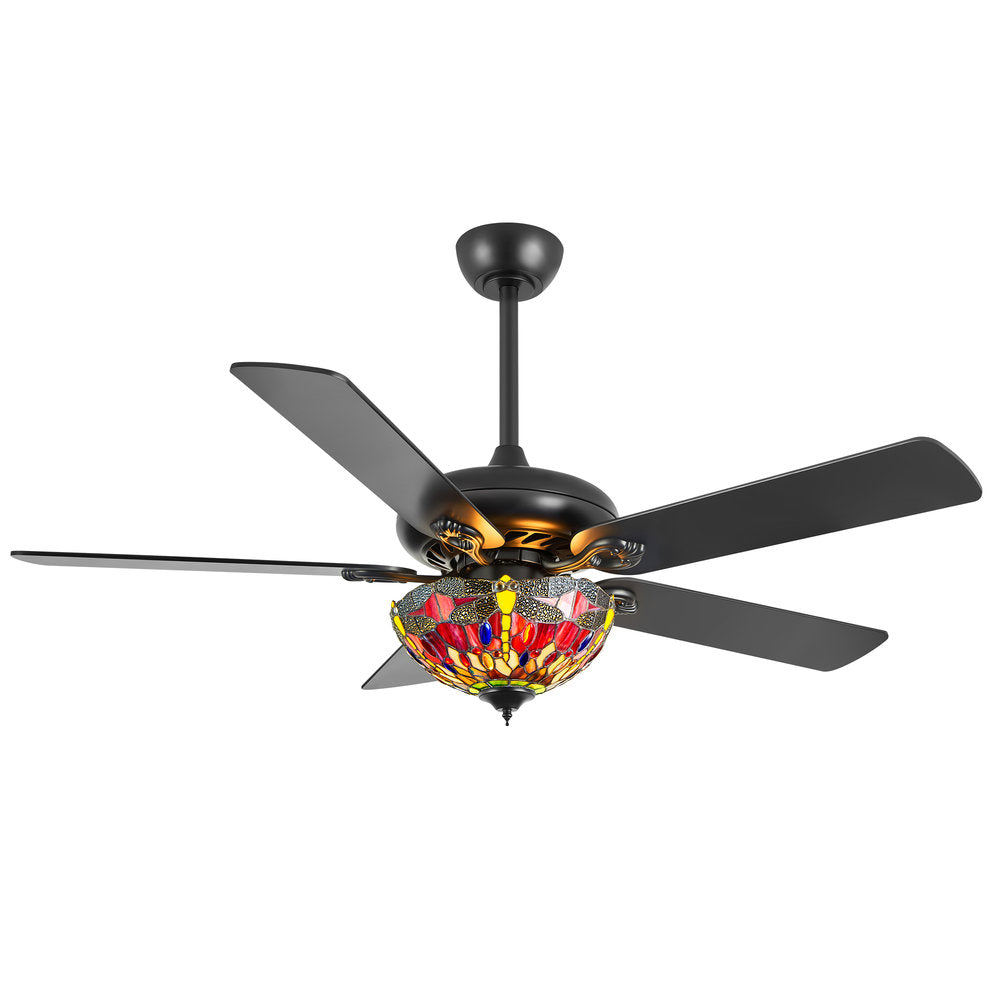
- Tiffany-style glass: colored glass shades with patterns such as dragonflies or florals, a look tied to the turn of the 20th century.
- Schoolhouse globes: white or opal glass shades of the kind used in early 20th-century schools and shops.
- Seeded glass: clear glass with small bubbles, which reads like an old lantern or a farmhouse fixture.
- Art Deco clues: strong geometry, symmetry, stepped shapes and bright metal, associated with the 1920s and 1930s.
- Ornate or distressed cages: floral cutouts and aged paint, a cottage or antique-shop look.
- Mid-century lines: simple tapered forms and walnut tones from the 1950s and 1960s.
Breezary's current range leans on Tiffany-style glass, seeded glass, crystal and decorative cages. There is no schoolhouse-globe model in the lineup right now, so if that is the look you want, search for a white opal glass shade and confirm the bulb base before buying.

Which Breezary Fans Have a Vintage Look?
Five Breezary models show the main vintage cues well, from a small floral cage to a large seeded-glass lantern fan.
| Model | Vintage cue | Size and mount | Light |
|---|---|---|---|
| Roson 16.5-Inch Vintage White Ceiling Fan | Floral cage, distressed white finish with golden paint | 16.5 in, flush mount, 8 in high | 4 E26 sockets, 10W max each |
| Tiffara 52 Inch Tiffany Ceiling Fan | Dragonfly Tiffany-style glass shade | 52 in, downrod | 2 E26 sockets, 10W max each, not dimmable |
| Levon 65-Inch Industrial Ceiling Fan | Seeded glass in an open metal cage, like an old warehouse lantern | 65 in, 8 blades, downrod | 2 E26 sockets, 15W max each |
| Osora 56-Inch 5-Blade Ceiling Fan | Bubbled seeded glass shade over walnut-finish blades | 56 in, downrod | 2 E12 sockets, 9W max each |
| Calivra 28-Inch Farmhouse Caged Ceiling Fan | Black iron framing with wood-grain bands | 28 in, 3 enclosed blades, downrod | 5 E26 sockets |
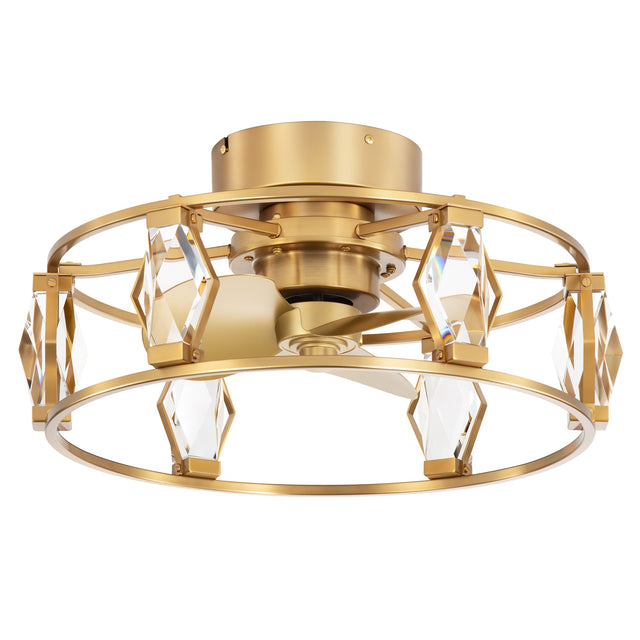
Roson and Calivra keep their blades inside a cage, so they read as light fixtures first. If you are weighing that kind of design against a fan with open blades, our guide to fandeliers versus caged and enclosed fans covers the trade-offs. Tiffara, Levon and Osora are full-size fans with the vintage detail concentrated in the light.

How Do You Match a Vintage-Style Fan to an Older Home?
Pick one era cue that fits the house, size the fan to the room, and keep the metal finish close to the other fixtures nearby.
Start with the house, not the fan
A seeded-glass lantern look suits a farmhouse kitchen or a converted barn. Tiffany-style glass fits a Victorian or Craftsman room with warm wood trim. A floral cage in an aged white finish suits a cottage bedroom. Mixing several eras in one fixture usually looks less convincing than committing to one.
Mind the ceiling height
Older homes often have low ceilings in bedrooms and high ceilings in front rooms. A flush-mount caged fan such as Roson keeps a small footprint, while a downrod fan like Tiffara needs more headroom. Our comparison of flush mount and standard ceiling fans explains the clearance trade-offs.
Check the ceiling box before you fall for a fixture
Many older homes have a light-only junction box where the old fixture hung. A fan needs a fan-rated box and support. See replacing a light fixture with a ceiling fan for what to check, and use a qualified electrician for the wiring.
Should You Buy a Real Antique Fan or a Retro Reproduction?
Buy an antique if you want a collectible and are willing to have it professionally inspected. Buy a retro reproduction if you want a fan you can run every day without worry.
An original old fan has history and character that a new fan cannot copy. It may also have worn insulation, an unknown motor condition, heavy mounting hardware and no current safety listing. Getting it safe to use is a job for a qualified professional, and the result can still be noisier and harder to control than a new fan.
A retro reproduction gives you the look with current features. The vintage-style models above all have reversible motors, six fan speeds and a handheld remote. Breezary fans also carry a limited lifetime warranty on the motor and a one-year limited warranty on fan parts and the light kit, for the original purchaser in the US.
Some people do both: they keep an antique as a display piece and install a vintage-style fan where the airflow is actually needed.
What Should You Check Before Buying a Vintage-Style Ceiling Fan?
Look past the style photo and confirm the shade material, bulb limits, dimming, size and location rating on the product page.
- Shade material. Glass, crystal and acrylic look different when lit. The spec list names it, for example "Glass" for Tiffara and "Metal, Glass" for Levon.
- Bulb base and maximum wattage. E26 and E12 sockets take different bulbs. Stay within the listed limit, such as 9W per bulb on Osora.
- Dimming. Several vintage-style models are not dimmable. Roson's listing warns against connecting it to a dimmer wall switch or rheostat.
- Size for the room. A small decorative fan moves far less air than a 52-inch or larger fan. Compare listed airflow using our CFM guide.
- Where it can go. Read the listed use location and the manual before putting a fan in a damp spot.
Want the vintage look with modern controls?
View vintage ceiling fans with lightsVintage, Antique and Retro Ceiling Fan FAQ
Is a brass ceiling fan always an antique?
No. A brass or gold color only tells you how the surface looks. New fans use gold-tone paint, plating and lacquer, and many genuinely old fans were painted black or other colors. Age is shown by maker labels, construction and documented history, not by color.
How old does a ceiling fan have to be to count as antique?
The usual line is about 100 years, which is also the age U.S. Customs uses for antiques. "Vintage" has no fixed definition; it usually means a few decades old, and in stores it often just means vintage-style.
What is a retro ceiling fan?
A retro fan is a new fan designed to look like an earlier era, such as a Tiffany-style glass shade, a seeded-glass lantern or an aged cage finish. Inside, it uses current parts such as a DC motor, a remote and modern bulb sockets.
Can I use an antique ceiling fan in my home?
Only after a qualified electrician has inspected it. Old insulation, motors and mounting hardware can be unsafe even when the fan looks fine. This guide does not cover restoring old electrics; for a fan you will run every day, a new vintage-style model is the simpler choice.
Do vintage-style ceiling fans use old-fashioned bulbs?
Many use standard sockets, so you can pick the bulb look you like within the listed limit. For example, the Tiffara 52-inch fan uses two E26 sockets with a 10W maximum per bulb, and its light is not dimmable.
Which vintage-style fan suits a small room?
A compact flush-mount design works best. The Roson 16.5-inch fan is 8 inches high, keeps its seven blades inside a floral cage and is listed for rooms of about 75 to 175 sq. ft.