Key takeaways
- CFM is airflow volume. Blade span is how wide a fan is and RPM is how fast it spins; none of them can stand in for the others.
- Pick the fan size from your room first, then compare CFM between fans of that size.
- Many medium- to high-output home fans list about 4,000–7,000 CFM. Treat that as a reference point, not a requirement.
- For efficiency, compare CFM per watt measured at the same speed, and make sure the fan also runs gently on low.
What Is CFM on a Ceiling Fan?
CFM stands for cubic feet per minute: the volume of air a fan moves in one minute under its stated test conditions. Higher CFM means more total airflow. It doesn’t tell you how wide the fan is, how fast it spins or exactly how the breeze will feel where you sit.
| Spec | What it tells you |
|---|---|
| Blade span | How wide the fan is, from blade tip to blade tip |
| CFM | How much air the fan moves |
| RPM | How fast the blades turn (revolutions per minute) |
| Watts | How much power the fan uses |
| CFM/W | How much air it moves for each watt (efficiency) |
Easy way to remember it: blade span is how wide, RPM is how fast, CFM is how much air.
Where to Find a Fan’s CFM
Most ceiling fans sold in the U.S. carry the FTC’s EnergyGuide label. It lists the fan’s airflow in CFM, its energy use in watts and its airflow efficiency in CFM per watt, plus an estimated yearly energy cost based on 6.4 hours of use a day at 12 cents per kWh, not counting lights. If a fan can be mounted more than one way, the label shows the least efficient setup.
Large-diameter fans and high-speed small-diameter fans don’t carry the label, so check their spec sheet or manual.
Ceiling Fan CFM Chart: How to Read Airflow Ratings
Use these bands to see where a fan’s published airflow sits compared with other fans. They’re a comparison scale, not a rule for how much CFM a room needs.
| Published airflow | Where it sits |
|---|---|
| Under 3,000 CFM | Lower total airflow |
| 3,000–4,000 CFM | Moderate airflow; the fit depends on fan size and the room |
| 4,000–5,000 CFM | Strong airflow for many home ceiling fans |
| 5,000–6,000 CFM | High airflow for a home fan |
| 6,000–8,000 CFM | Very high airflow, common among larger, high-output fans |
| 8,000–10,000+ CFM | Large or high-output fans; room size, mounting height and speed control matter most |
Why the same number can feel different: 4,000 CFM from a compact fan and 4,000 CFM from a much larger fan are spread over different areas at different air speeds, and a fan hung closer to you feels stronger than one far overhead.
What Is a Good CFM for a Ceiling Fan?
A good CFM gives the room enough airflow on high and comfortable, controllable airflow at everyday settings. Many medium- to high-output home fans list roughly 4,000–7,000 CFM; use that as a reference point. A bedroom usually benefits more from gentle low speeds, while a great room or covered patio can use much more total airflow.
Is 4,000 CFM Good for a Ceiling Fan?
It can be. 4,000 CFM is useful airflow in many rooms. For a larger or open room, compare higher-output fans that suit the room’s size.
Is 5,000 CFM Good for a Ceiling Fan?
Usually. 5,000 CFM is relatively strong airflow for a home ceiling fan. But 5,000 CFM from a 52-inch fan isn’t the same as 5,000 CFM from a much larger one, so compare it with fans of the same size.
Is 10,000 CFM Good for a Ceiling Fan?
It’s very high for a home-style fan. It makes sense in very large rooms, great rooms, high-ceiling spaces and covered outdoor areas with a matching location rating. In an ordinary room, make sure the fan also has gentle low speeds.
Ceiling Fan CFM for Room Size
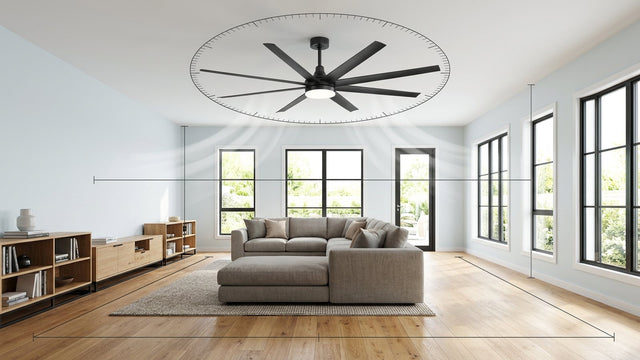
Room size tells you what size fan to start with; it can’t give you an exact CFM. Choose the fan size first, then compare CFM among fans of that size.
| Room size | Starting fan size | Typical rooms |
|---|---|---|
| Up to 75 sq. ft. | 29–36 in. | Small office, closet, reading nook |
| 75–175 sq. ft. | 42–48 in. | Bedroom, kitchen, home office |
| 175–350 sq. ft. | 52–56 in. | Large bedroom, living room, primary suite |
| Over 350 sq. ft. | 60 in. or larger | Great room, open-plan space |
| Long or divided room | Two or more fans may work better | Long living room, divided open-plan room |
From our guide What Size Ceiling Fan Do I Need?
Once you know the size, compare:
- Bedroom: low-speed comfort and noise, not just maximum CFM
- Living room: CFM together with where the seating is
- Great room or open plan: total airflow, mounting height and whether one fan can reach every zone
- Covered patio: CFM plus a damp or wet location rating
How Many CFM Do I Need for a 12x12 Room?
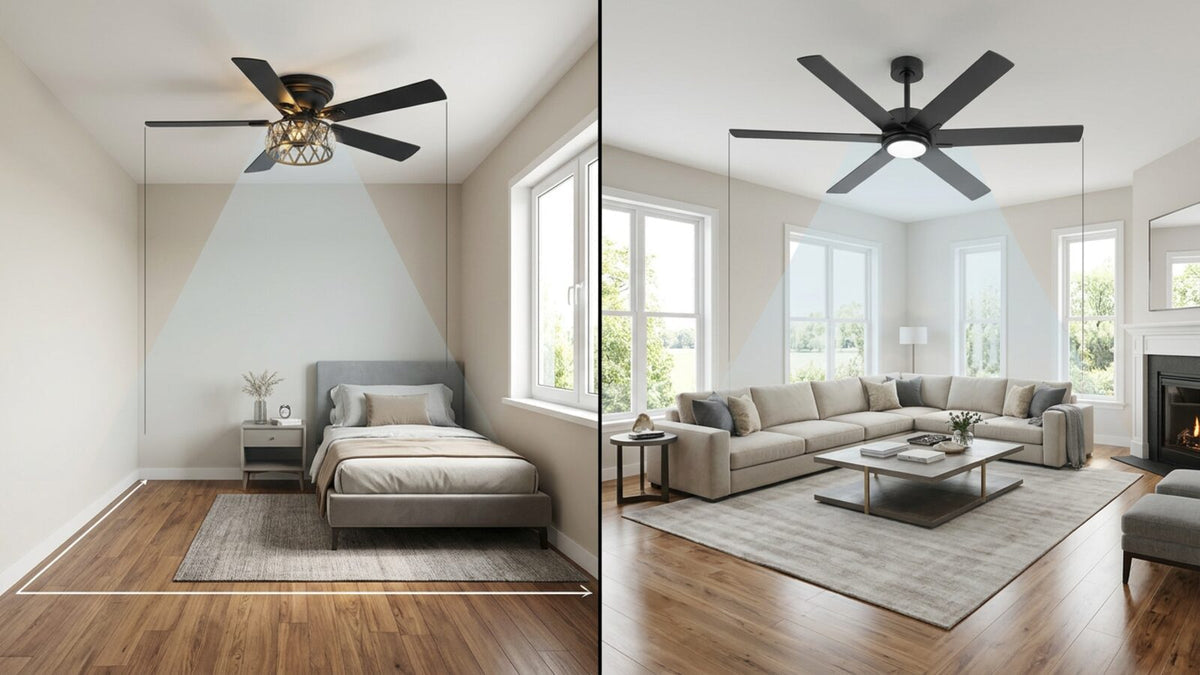
A 12x12 room is 144 sq. ft., so start with a 42–48-inch fan; a 52-inch fan can work if the layout and clearances allow. There’s no exact CFM target. Compare published CFM among fans of that size, and in a bedroom or office, favor quiet, gentle low speeds.
How Much CFM Do I Need for a 20x20 Room?
A 20x20 room is 400 sq. ft. Start with a 60-inch or larger fan, or plan two fans if the room is long or split into zones. A square room with one seating area is easier for one central fan to cover than a long open-plan space of the same size.
Can a CFM Calculator Tell You Exactly What You Need?
No. Room dimensions can’t produce a precise airflow requirement; a result like “4,736 CFM” is false precision. Use our Fan Size Calculator to get a starting size and mounting advice, then compare CFM among fans that fit.
Enter your room size and ceiling height to get a starting fan size.
Open the Fan Size CalculatorBlade Span, Blade Count and RPM vs. CFM
A fan’s CFM comes from the whole design: motor, blade shape and pitch, speed and size. That’s why no single visible feature tells you how much air it moves.
Do Longer Blades Move More Air?
Not automatically. Longer blades sweep a bigger area, but airflow still depends on the motor, blade pitch and speed. Never fit longer blades than the model was designed for.
Does Blade Count Affect CFM?
Blade count is part of the design, not an airflow rating. A 3-, 5-, 6- or 10-blade fan can move more or less air depending on everything else, so compare published CFM instead, even between two fans with the same blade span.
CFM vs. RPM: What’s the Difference?
| Compare | CFM | RPM |
|---|---|---|
| Measures | Air volume | Rotation speed |
| A higher number means | More air moved | Faster blades |
| Use it to | Compare airflow between fans | Understand a fan’s speed settings |
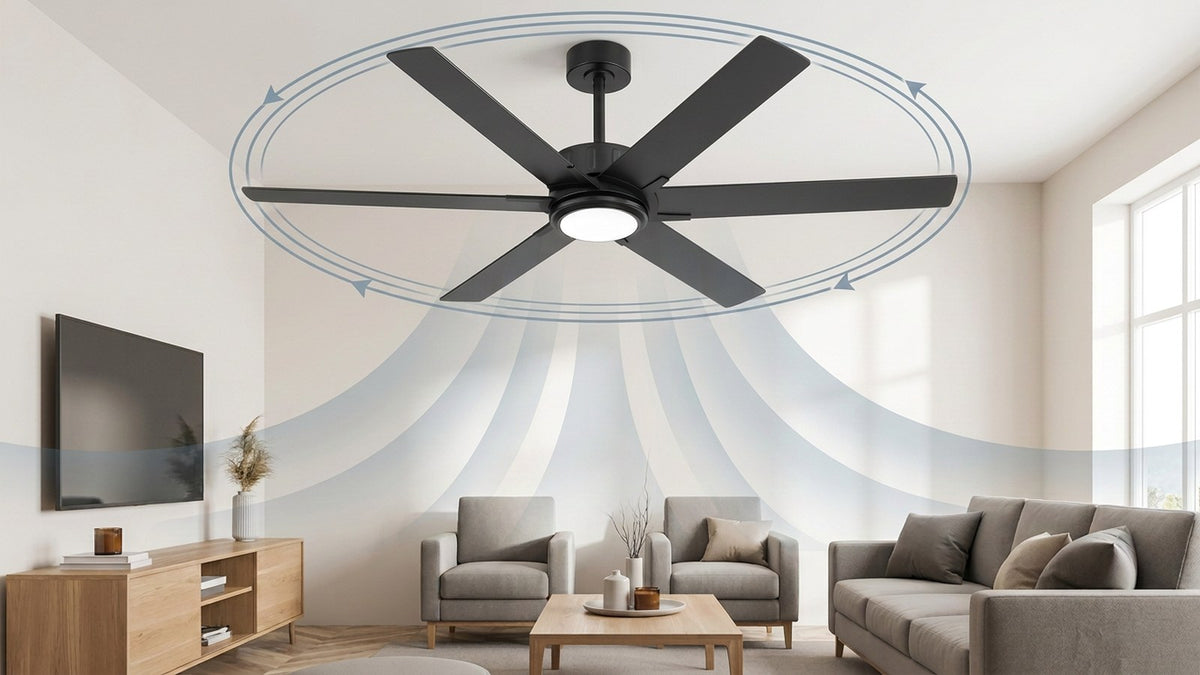
Higher RPM doesn’t always mean higher CFM. Two fans at the same RPM can move different amounts of air, and a larger fan can turn more slowly yet still move a lot of air because its blades sweep a bigger area.
What Is a Good CFM for a 52-Inch Ceiling Fan?
There’s no single number every 52-inch fan must hit. Confirm that 52 inches suits the room, then compare published CFM, CFM per watt and speed range among 52-inch fans. Check the installed height too: of two of our 52-inch fans, one has an installed height of about 12 inches and the other about 14 or 19 inches, depending on which included downrod you use.
CFM per Watt: How to Compare Efficiency
CFM per watt (CFM/W) is airflow divided by power: how much air a fan moves for each watt it uses. Higher means more efficient. It’s an efficiency measure, not an estimate of your electric bill.
CFM÷watts=CFM/W
Compare like with like: use airflow and watts measured at the same speed, ideally from the EnergyGuide label or spec sheet. Don’t divide a high-speed CFM by a maximum wattage taken from somewhere else.
Efficiency isn’t everything. An efficient fan can still move less air in total, and CFM/W says nothing about noise or low-speed comfort. Use it to choose between fans that already fit the room and move enough air. DC motors are typically quieter and more efficient than AC motors and often offer more speeds.
Compare Two Fans
Example values. Enter the numbers from two fans you’re considering.Fan B moves 20% more air; Fan A moves 25% more air per watt.
*Uses the EnergyGuide label’s basis (6.4 hours a day at 12 cents per kWh) and the watts you enter. Your cost depends on your rates and use.
High-CFM Ceiling Fans
“High CFM” is a comparison term, not a fixed threshold. On the chart above, 5,000–6,000 CFM is high for a home fan, 6,000–8,000 CFM is very high, and 10,000 CFM puts a fan among the large, high-output models.
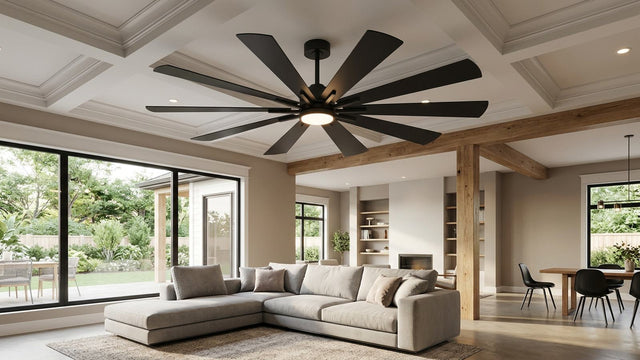
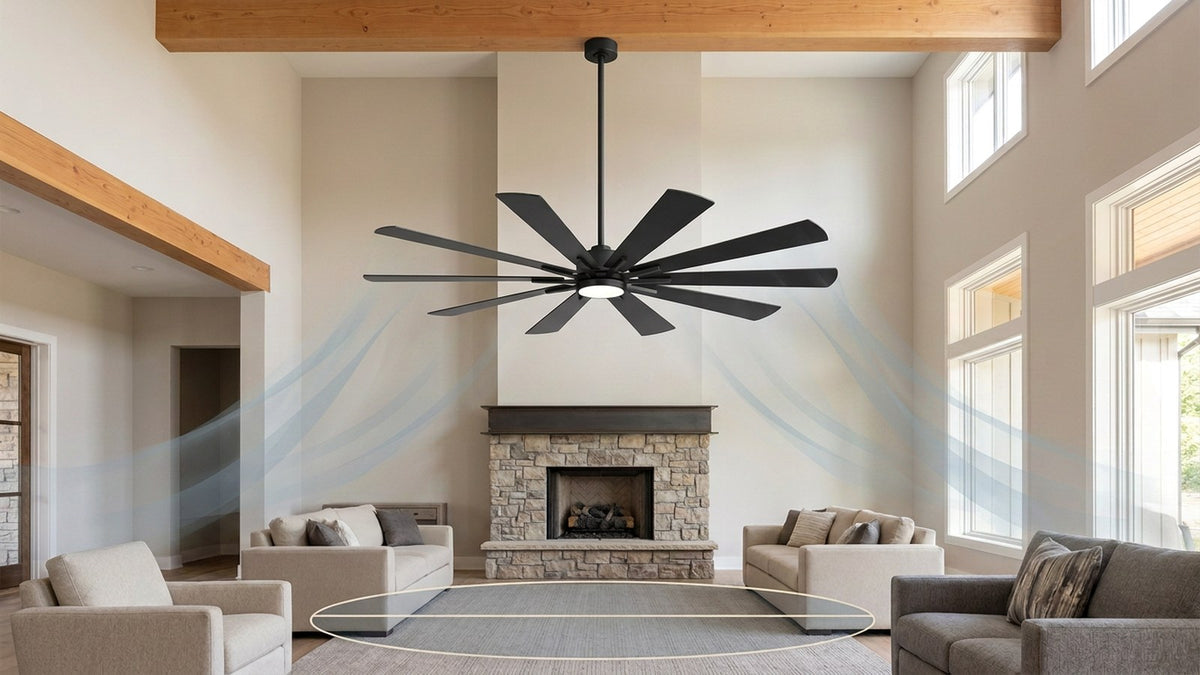
High airflow pays off in great rooms and open-plan spaces, under high or vaulted ceilings, and on covered patios and porches (with a damp or wet rating). Before you buy, check that the fan also runs gently on low and compare CFM per watt: a 6,500 CFM fan should still be judged by its size, power use and where it’s going.
Can a High-CFM Ceiling Fan Have a Light?
Yes. The light and the airflow are separate specs, so compare CFM on its own first. Then check the light: integrated LED or bulbs, brightness, color temperature and dimming. Don’t confuse the light’s watts with the fan motor’s watts.
Shop fans for large rooms and patios
Warehouses and other very large spaces use HVLS fans, which are compared differently. See Is CFM the Best Way to Compare HVLS Fans?
How CFM Feels in a Real Room
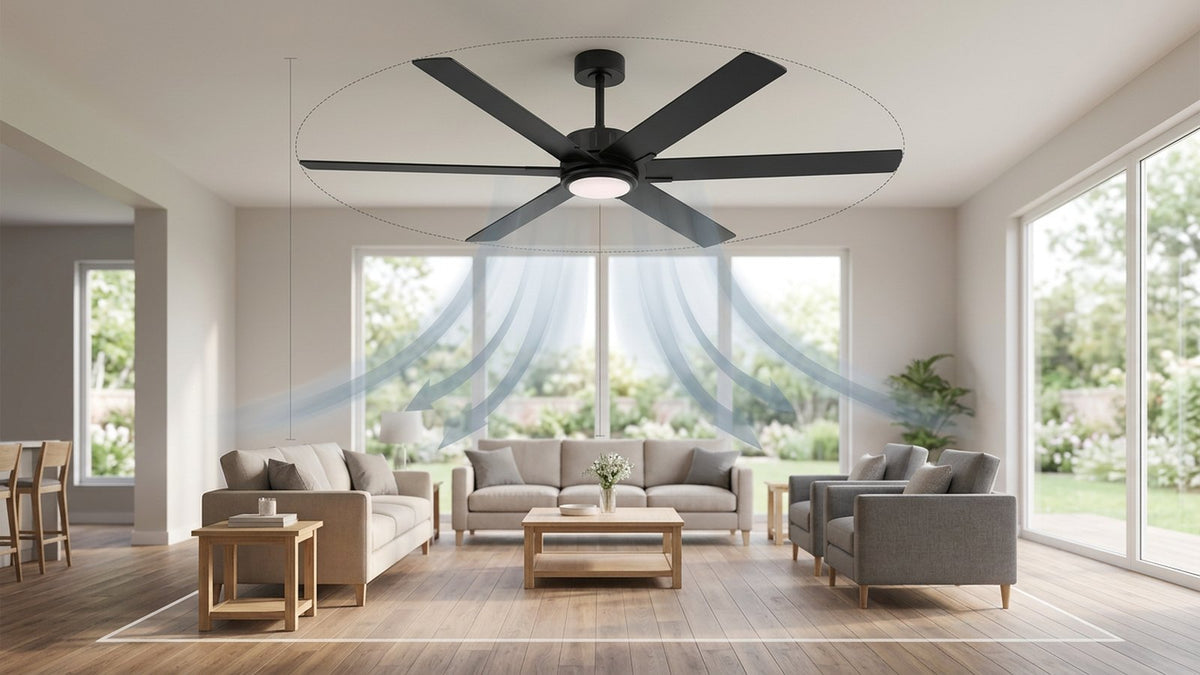
CFM is total volume. The breeze you feel depends on how fast the air is moving where you are, and that changes with fan size, mounting height, blade design and where you sit.
What Does 4,000 CFM Feel Like?
There’s no single answer. A compact fan concentrates its 4,000 CFM over a smaller area, so it can feel stronger directly underneath than a larger fan spreading the same 4,000 CFM across the room. CFM compares fans; it can’t predict the breeze at your sofa.
Can Ceiling Fan CFM Be Too High or Too Low?
Yes. Aim for airflow you can control: enough on high, gentle on low.
Too little airflow
- You run the fan on high all the time
- The edges of the room get little air
- One part of the room feels comfortable and another doesn’t
Too strong
- A direct breeze over beds, desks or seating
- Papers and other light objects move
- More fan than the room needs, with high speeds you rarely use
Ceiling Height and Room Layout
| Room | What to check |
|---|---|
| Low ceiling (about 8 ft or less) | A flush-mount (low-profile) fan; keep the blades at least 7 ft above the floor |
| High ceiling | A longer downrod to bring the fan closer to the room; we sell extension downrods from 24 to 72 in. |
| Vaulted or sloped ceiling | Sloped-ceiling compatibility and blade clearance |
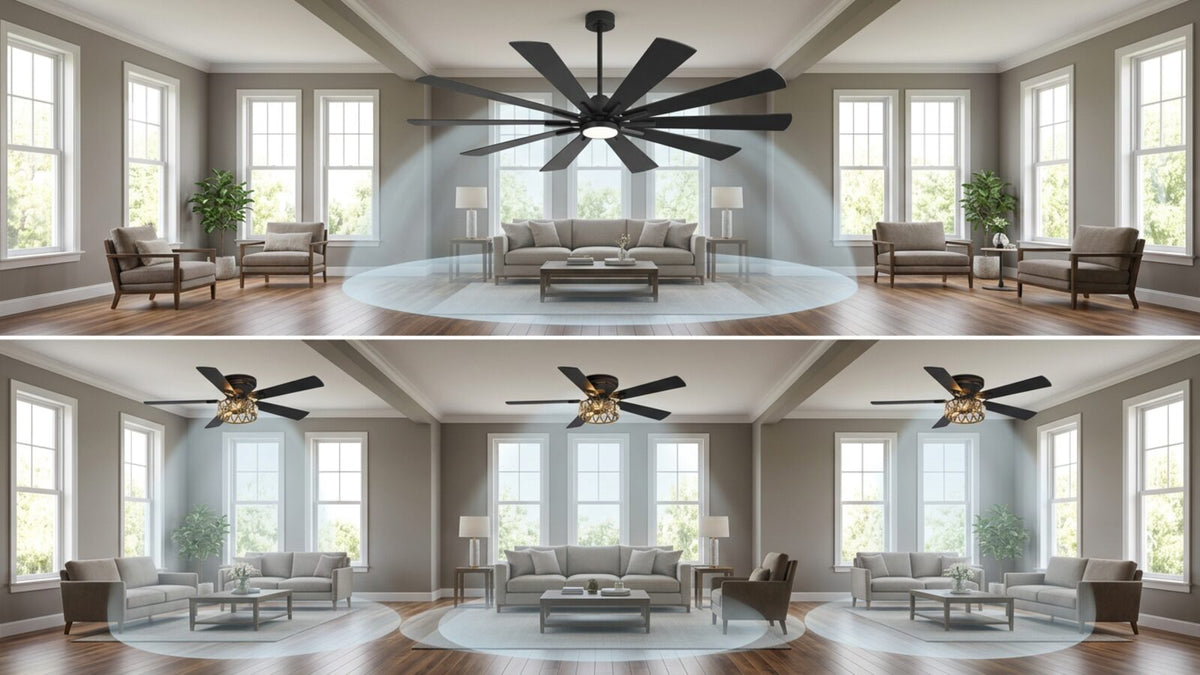
| Long, L-shaped or open-plan room | Whether one central fan can reach every zone, or two fans would cover it better |
| Beams and furniture | Where the fan can be mounted and where people actually sit |
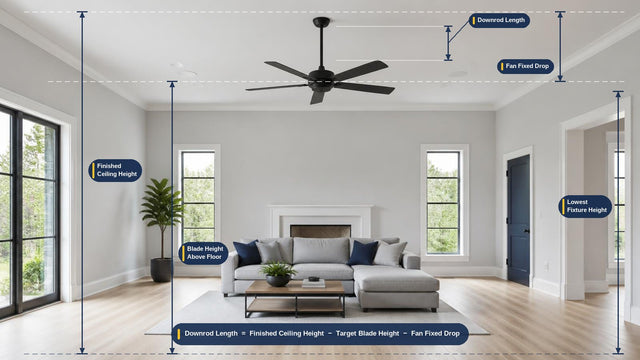
A different downrod doesn’t change a fan’s CFM; it changes where the airflow lands. Use the Downrod Length Calculator to plan the hanging height, and see Flush Mount vs Standard Ceiling Fans for low ceilings.
One Large Fan or Multiple Fans?
| Compare | One large fan | Multiple fans |
|---|---|---|
| Works best in | Open, roughly square rooms with central seating | Long, L-shaped or multi-zone rooms |
| Airflow | Strong and centered | Spread across zones |
| Control | One control point | Zones can often run separately, depending on the models |
| Installation | One fan-rated mounting point | Several fan-rated mounting points and more wiring |
How to Compare Ceiling Fan CFM Before You Buy
- Measure the room
Length, width and ceiling height; note slopes, beams and where people sit.
- Choose a starting size
Use the room size to narrow the blade span, or let the Fan Size Calculator do it.
- Compare published CFM
Among fans of that size, at the same speed setting.
- Check CFM per watt
Use the fan motor’s watts, not the light’s.
- Check low-speed comfort
Number of speeds, low-speed airflow and noise, especially for bedrooms.
- Check the installed fit
Overall height, downrod, blade clearance, light, controls and location rating.
Rule of thumb: fit first, verified airflow second, features third.
Airflow Spec Checklist
- Published CFM and the speed it’s measured at
- CFM per watt
- Fan motor watts (separate from the light)
- RPM by speed, if listed
- Blade span
- Overall height and included downrods
- Number of speeds and remote functions
- Reverse function
- Light type
- Indoor, damp or wet rating
- Installation manual
If a fan’s CFM isn’t published, don’t estimate it from blade span or blade count.
Ceiling Fan CFM FAQ
What does CFM mean on a ceiling fan?
Cubic feet per minute: the volume of air a fan moves in one minute under its stated test conditions. It measures airflow, not blade size, rotation speed or the exact breeze you feel at one spot.
What is a good CFM for a ceiling fan?
One that gives the room enough airflow on high and comfortable airflow on low. Many medium- to high-output home fans list about 4,000–7,000 CFM; compare fans of the size your room needs rather than chasing the highest number.
How many CFM do I need for my room?
There’s no exact CFM for a given square footage. Use the room size to pick the fan size (for example, 42–48 inches for 75–175 sq. ft.), then compare CFM among fans of that size.
Where can I find a ceiling fan’s CFM?
On the EnergyGuide label, which lists airflow (CFM), energy use (watts) and airflow efficiency (CFM per watt), and in the spec sheet or manual. Large-diameter and high-speed small-diameter fans don’t carry the label.
What does CFM per watt mean?
Airflow divided by power. A higher CFM/W means the fan moves more air for each watt, as long as both numbers are measured at the same speed.
Do more blades or a higher RPM mean more CFM?
Not necessarily. Blade count and RPM are only part of the design; blade size, pitch and the motor matter too. Compare published CFM instead.
Does a higher-CFM fan make more noise?
Not necessarily, but don’t assume a high-airflow fan stays just as quiet. Compare published sound information when it’s available. DC motors are typically quieter than AC motors.
What is the highest CFM ceiling fan?
There’s no permanent answer, because products and published ratings change. Instead of hunting for the highest number, compare current CFM ratings among fans that suit your room size, ceiling height and location.