
Do Large Ceiling Fans Work Better?
LARGE CEILING FAN PERFORMANCE GUIDE
Large ceiling fans can work better in large or open rooms because a wider blade span can distribute airflow across a broader occupied area, sometimes at lower rotational speeds. However, bigger is not automatically better. Actual performance depends on published CFM, motor and blade design, speed range, ceiling height, mounting position, clearances and room layout. A fan that is too large may feel drafty or fit poorly, while one central fan may not serve a long or divided space. Compare diameter with verified airflow and installation data before choosing a model.

QUICK ANSWER
Do Bigger Ceiling Fans Make a Difference?
Yes, bigger ceiling fans can make a noticeable difference in large or open rooms by spreading air movement across a wider occupied area. However, if you are asking “are larger ceiling fans better?”, the accurate answer is: only when the fan’s diameter, published airflow, mounting height and placement match the room.
A properly selected large ceiling fan for a living room, great room or open-plan area may provide broader coverage than a smaller fan positioned in the same central location. In an open, symmetrical room, that wider coverage may also reduce the need for multiple smaller fans.
A larger ceiling fan may provide:
- Wider airflow coverage across the room.
- Broader air movement through the occupied zone.
- Gentler airflow across a wider area on some speed settings.
- Better physical coverage in large living rooms, great rooms and open-plan areas.
- A possible alternative to multiple fans in an open, regularly shaped room.
Bigger does not automatically mean better performance.
- A larger diameter does not guarantee higher CFM.
- A larger diameter does not guarantee lower energy use.
- A larger diameter does not guarantee quieter operation.
- A large fan is not automatically suitable for every high-ceiling room.
- Motor design, blade profile, blade pitch and speed range vary by model.
Quick Room and Installation Check
| Scenario | Is a Larger Ceiling Fan Likely to Work Better? |
|---|---|
| Large open room | Possibly. A wider blade span may provide broader coverage when the fan has a suitable central mounting position. |
| Long or divided room | Not necessarily. Multiple fans may distribute airflow more evenly across separate occupied zones. |
| Small bedroom | Often not. An oversized fan may feel visually dominant, create an uncomfortable draft or fail required clearances. |
| High ceiling | It depends. Large ceiling fans for high ceilings must also be evaluated by downrod length, installed blade height and mounting compatibility. |
| Same diameter, different models | Compare published CFM and model-specific specifications. Equal diameters do not prove equal airflow. |
| Low ceiling | Check the fan’s complete installed height, mounting configuration and required clearances before choosing a larger diameter. |
AIRFLOW COVERAGE
How Does a Larger Ceiling Fan Change Airflow?
A larger ceiling fan changes the physical area through which its blades rotate. That wider rotating area can help spread air movement across more of a large room, but it does not prove that the fan produces more total airflow than every smaller model.

Wider Airflow Coverage
Blade span describes the diameter of the circle created when the fan rotates. Increasing that diameter may allow a fan to influence a broader area of air, particularly in a wide room with a clear central mounting position.
- Blade span determines the physical diameter of the rotating fan.
- A wider rotating area may reach more of the occupied portion of a room.
- Open, regularly shaped rooms usually provide a clearer path for broad airflow coverage.
- Wider coverage should not be described as guaranteed higher CFM.
Broader Air Movement at Lower Speeds
Some large ceiling fans can produce a broad, gentle airflow pattern at lower rotational speeds. This may feel more comfortable than a concentrated stream of faster-moving air in certain large spaces. However, lower RPM does not automatically mean lower airflow, lower noise or lower power use.
RPM should therefore be interpreted together with blade design, motor performance, speed range and published CFM. A general airflow principle should not be treated as a verified performance claim for every large fan.
Coverage Is Not the Same as Performance
Blade span describes physical size. Published CFM describes airflow volume. Neither measurement by itself explains how comfortable a particular fan will feel in every room. Ceiling height, mounting position, furniture layout, room shape and occupied zones also affect the result.
BLADE LENGTH AND AIRFLOW
Do Longer Ceiling Fan Blades Move More Air?
If you are wondering “do longer fan blades move more air?”, the answer is that longer blades can contribute to a wider airflow pattern, but blade length alone does not determine how much air a ceiling fan moves.
A longer blade changes the fan’s physical reach, but actual performance depends on the complete fan system. Two fans can have a similar overall diameter and still publish different airflow values because their motors, blade profiles, blade pitch and operating speeds are different.
Compare the following factors together:
- Complete blade span
- Blade length
- Blade pitch
- Blade profile
- Motor design
- RPM
- Available speed range
- Ceiling clearance
- Installation height
- Published CFM
What Each Ceiling Fan Measurement Actually Tells You
| Measurement | What It Can Tell You | What It Cannot Prove by Itself |
|---|---|---|
| Blade span | The complete diameter of the rotating fan. | Actual airflow volume, energy use or room comfort. |
| Blade length | The length of one individual blade. | The complete fan diameter or total airflow. |
| Blade count | How many blades are included in the fan design. | Which model produces more airflow or cooling comfort. |
| RPM | How quickly the fan rotates at a specified setting. | Total airflow coverage, noise level or power consumption. |
| Published CFM | The published volume of air moved per minute under the stated conditions. | Whether the fan will feel equally comfortable in every room layout. |
| CFM/W | A reference for airflow delivered relative to power use. | Whether the fan size, mounting system or installed height suits the room. |
To understand how published airflow figures are used when comparing fan models, read Ceiling Fan CFM Explained .
SIZE AND COVERAGE COMPARISON
Large vs Small Ceiling Fans: What Actually Changes?
The most visible difference in a large vs small ceiling fan comparison is the diameter of the rotating area. A larger fan may spread air movement across a broader zone, while a smaller fan can be easier to position in a compact or clearly defined space. Size alone, however, does not establish which model produces more airflow.
When asking “are larger ceiling fans better?”, compare the room shape, occupied area, mounting location, complete installed dimensions and published performance data—not diameter alone.
| Factor | Larger Ceiling Fan | Smaller Ceiling Fan |
|---|---|---|
| Blade span | Wider rotating diameter | Narrower rotating diameter |
| Potential coverage | May influence a broader area | May provide more concentrated coverage |
| Typical room | Large, open or broadly occupied room | Compact or clearly defined room |
| RPM | May operate at lower rotational speeds, depending on the model | May operate at higher rotational speeds, depending on the model |
| Draft sensation | May feel broad and gentle at a suitable speed | May feel more concentrated beneath the fan |
| Horizontal clearance | Requires more unobstructed ceiling space | Usually easier to fit within a compact area |
| Visual proportion | Often appears more proportional in a spacious room | Often appears more proportional in a compact room |
| Room layout | May suit one broad, central occupied zone | Multiple units may serve separate zones |
| Final comparison | Check published CFM and complete dimensions | Check published CFM and complete dimensions |
These are general tendencies, not guaranteed performance differences between every large and small ceiling fan.
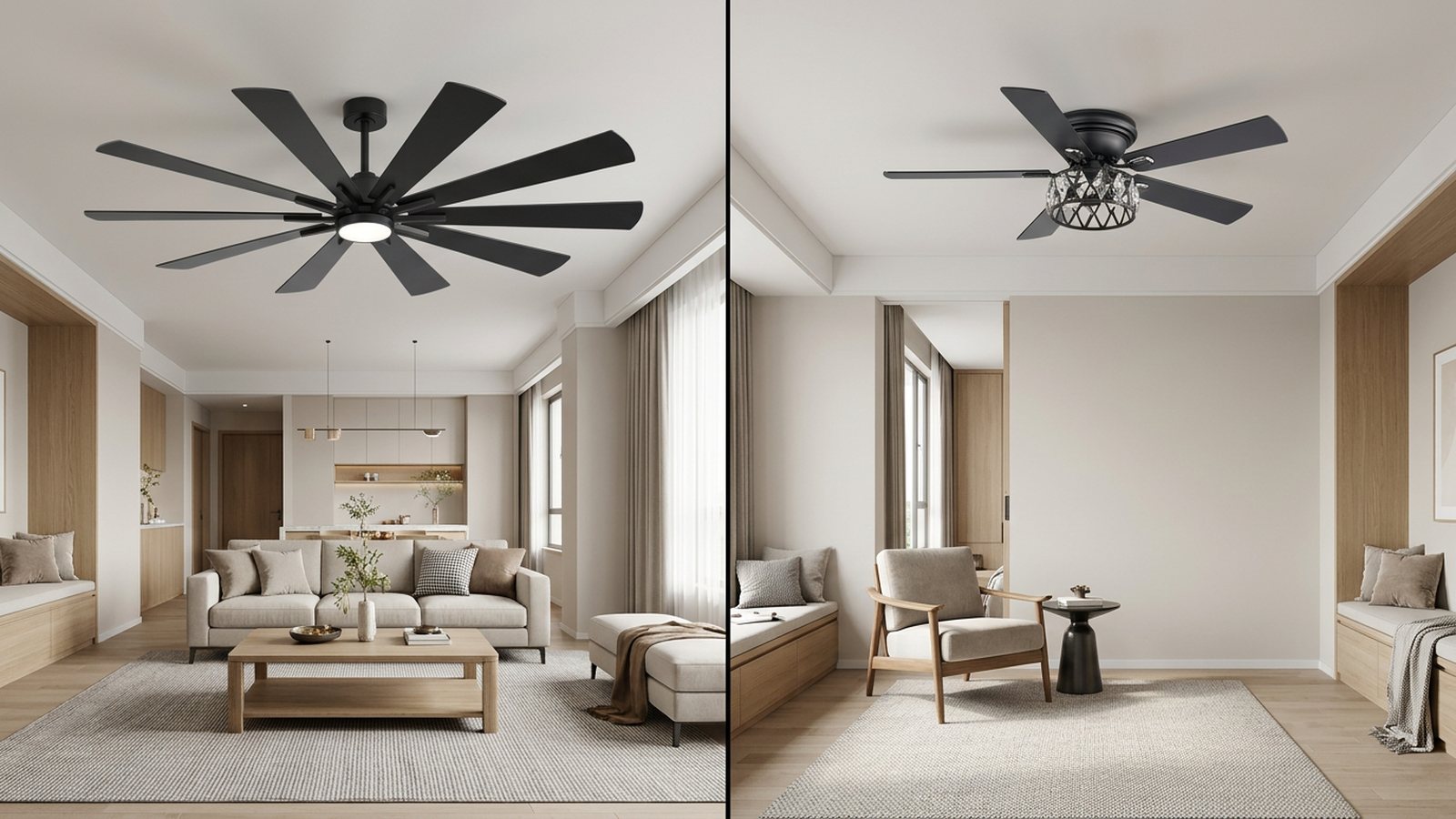
The comparison uses the Breezary 62/72-Inch Large Ceiling Fan with Light in its 72-inch configuration and the Breezary 52-Inch Ceiling Fan with Caged Light .
SUITABLE ROOM CONDITIONS
When Does a Large Ceiling Fan Work Better?
A large ceiling fan is most likely to work well when its wider rotating diameter corresponds with a broad occupied zone, the room provides sufficient clearance and the selected model has appropriate published performance and installation specifications.
Large Living Rooms
Do large ceiling fans work better for living rooms? They can when the living room has a spacious seating area, a suitable central mounting point and enough unobstructed ceiling space for the fan’s complete blade span.
A large ceiling fan for a living room should be evaluated against:
- The width and position of the main seating area.
- The location of the fan-rated ceiling box.
- Horizontal clearance from walls, beams, cabinets and fixtures.
- The width of the occupied zone rather than unused corners.
- Published CFM and other model-specific performance information.
Great Rooms and Open-Plan Areas
An open and reasonably symmetrical great room may allow one centrally positioned large fan to distribute air across a broad area. The decision becomes less straightforward when an open-plan space contains several distinct activity zones.
A connected kitchen, dining area and living room may appear to be one large room, but each section can have different occupancy patterns and airflow needs. Do not simply add the total floor area and automatically select the largest available fan.
Rooms With a Wide Occupied Zone
The area people actually use is often more important than the room’s total square footage. A ceiling fan should primarily serve the seating, working, dining or living zone where occupants are most likely to benefit from air movement.
Hallways, unused corners and circulation paths may not require the same airflow intensity as the main occupied zone. Choosing by usable airflow area can therefore be more practical than choosing only by the room’s outer dimensions.
Large Covered Outdoor Areas
A large covered patio, porch or pavilion may benefit from broader airflow coverage, particularly when the occupied seating area is wide and unobstructed.
Always verify the model’s stated damp- or wet-location suitability. An indoor ceiling fan should not be installed outdoors merely because its diameter is large enough for the space.
SIZE LIMITATIONS
When Is a Larger Ceiling Fan Not Better?
A larger ceiling fan is not automatically the better choice when its diameter, installed height or airflow pattern does not suit the room. Oversizing can affect comfort, visual proportion, clearances and the fan’s ability to serve separate occupied zones.
The Room Is Too Small
In a compact room, an oversized ceiling fan may create practical and visual problems even if it can physically be installed.
- The lowest speed may still feel too drafty for occupants.
- The ceiling may look visually crowded.
- Blade clearance may be insufficient.
- The blades may conflict with lighting, doors, cabinets or architectural features.
- The fan may appear disproportionate to the room.
The Ceiling Is Too Low
Fan diameter and installed height are separate measurements. A wide fan may have a suitable diameter for the floor area but still hang too low because of its motor housing, canopy, downrod or light assembly.
Check the complete installed height, mounting configuration and required blade-to-floor clearance for the specific model. Do not assume that every extra-large fan requires the same ceiling height.
The Room Is Long or Divided
One very large fan may not distribute air evenly through a long, divided or irregular room. This commonly applies to:
- Long great rooms
- L-shaped rooms
- Combined kitchens and living rooms
- Rooms divided by exposed beams
- Spaces with separate seating zones
In these spaces, mounting position and zone coverage may matter more than selecting the largest possible diameter. A dedicated later comparison considers one large ceiling fan vs multiple small fans in more detail.
The Fan Is Large but Lacks Verified Performance Data
Product size and performance are related but not interchangeable. Without comparable published airflow information, diameter alone cannot establish which ceiling fan moves more air.
| Product Information | What It Actually Establishes |
|---|---|
| Diameter | Establishes physical blade span, not total airflow. |
| Blade count | Establishes the number of blades, not which model produces more airflow. |
| “Powerful” description | A marketing description that cannot replace comparable performance data. |
| Published CFM | Provides an airflow-volume reference when the figure is published for the specific model. |
ROOM FIT AND CLEARANCE
Can a Ceiling Fan Be Too Big for a Room?
Yes, a ceiling fan can be too big for a room. A fan is oversized when its blade span or installed height cannot meet the model’s required clearances, when the lowest speed still feels uncomfortably drafty, or when one wide fan cannot serve the room’s separate occupied zones. Visual proportion also matters, but appearance should not replace installation checks. Even a 60 inch ceiling fan may be too large for one room and appropriate for another. Always compare room dimensions, fan diameter, mounting configuration, blade height and model-specific instructions.
How Do You Know If a Ceiling Fan Is Too Big?
The following warning signs indicate that a fan may be too large for its intended room or installation position:
- The installation cannot meet the required blade-tip clearance.
- Air movement feels too strong even at the lowest available speed.
- The fan’s complete installed height is unsuitable for the ceiling.
- The blade plane would be positioned too close to the floor.
- The blades conflict with lighting, cabinet doors, beams or architectural features.
- The room contains several occupied zones that one central fan cannot serve evenly.
- The fan appears visibly out of proportion with the room.
MODEL-SPECIFIC INSTALLATION EXAMPLE
Breezary Item #42004
Breezary Item #42004 illustrates why physical fit must be checked separately from diameter. Its manual specifies approximately 7.5 feet of floor clearance and 31 inches of wall clearance. These are model-specific installation references, not universal rules for every 72-inch fan.
| Manual Specification | Item #42004 |
|---|---|
| Blade span | 72 inches |
| Blade count | 7 blades |
| Approximate overall height | Approximately 15.24 inches |
| Approximate blade-plane profile | Approximately 13.43 inches |
| Manual floor clearance reference | Approximately 7.5 feet |
| Manual wall clearance reference | Approximately 31 inches |
Item #42004 is included as a manual-based fit example. No product link is added because a confirmed live product page is not currently available.
For room-size and blade-span guidance, read What Size Ceiling Fan Do I Need? .
FAN QUANTITY AND ROOM LAYOUT
One Large Ceiling Fan or Multiple Smaller Fans?
The choice between one large ceiling fan vs multiple small fans depends mainly on room shape, mounting positions and occupied zones. One large fan may suit an open, symmetrical room with a usable central ceiling point. Multiple smaller fans may provide more targeted airflow in a long, divided or irregular space.
| One Large Fan | Multiple Smaller Fans |
|---|---|
| Often better suited to an open, symmetrical room | Often better suited to a long, divided or irregular room |
| Uses one central mounting location | Requires multiple suitable mounting locations |
| Usually creates one control zone | May allow different occupied zones to be controlled independently |
| Can create one central visual feature | Provides more flexibility across separate sections |
| May provide broad airflow across one occupied area | May provide more targeted airflow in different areas |
| Requires one approved fan-rated ceiling box | Requires an approved fan-rated ceiling box for each fan |
Choose One Large Fan When
- The room is open and reasonably symmetrical.
- A suitable central mounting point is available.
- The selected model’s published CFM suits the intended use.
- Required horizontal and vertical clearances can be maintained.
- One shared airflow and control zone is appropriate.
Choose Multiple Fans When
- The room is long or L-shaped.
- The room contains separate seating, dining or working areas.
- Exposed beams or architectural features divide the ceiling.
- One fan cannot be positioned near the center of the occupied area.
- Different zones require independent operation or speed control.

The layout example uses one Breezary 72-Inch Large Ceiling Fan with Light and two Breezary 52-Inch Ceiling Fans with Caged Lights .
AIR MOVEMENT AND COOLING COMFORT
Does a Large Ceiling Fan Actually Cool a Room?
A large ceiling fan primarily moves air; it does not normally lower room temperature in the same way as an air conditioner. Moving air can help occupants feel cooler by increasing air movement across the skin. A larger fan’s potential advantage is that it may extend that cooling sensation across a broader occupied zone when the fan is properly sized and positioned.
Air Movement Creates a Cooling Sensation
Ceiling fans circulate room air and increase air movement around occupants. This can improve perceived comfort, especially when people are sitting, working or relaxing beneath the fan’s effective airflow area. The fan is therefore cooling the person through air movement rather than refrigerating the room’s air.
A Larger Fan May Reach More of the Occupied Zone
In a wide living room or great room, a properly selected large fan may distribute air movement across more seating positions than a smaller fan. That wider physical coverage can be useful, but the result still depends on published CFM, speed range, blade design, mounting height and room layout.
When choosing the best ceiling fan for cooling a large room, compare occupied-zone coverage, published airflow, speed control, mounting height and placement instead of selecting the largest diameter automatically.
What a Ceiling Fan Does and Does Not Do
| What a Ceiling Fan Can Do | What Should Not Be Assumed |
|---|---|
| Move air through an occupied area | That it lowers room temperature like air conditioning |
| Help occupants feel cooler through increased air movement | That a larger diameter guarantees a stronger cooling sensation |
| Potentially cover a wider occupied zone | That every large fan publishes higher CFM |
| Complement an appropriate HVAC and comfort strategy | A fixed percentage of air-conditioning cost savings |
Because the primary benefit is experienced by occupants, running a residential ceiling fan continuously in an empty room should not be described as continuously cooling that room. Any claim about energy savings must account for the complete HVAC setup, controls, climate and operating behavior.
HIGH-CEILING INSTALLATION
Do Large Ceiling Fans Work Better on High Ceilings?
A high ceiling may make a larger fan worth considering, but performance depends on where the fan is installed—not only on the ceiling’s total height. The blades must be positioned at an appropriate height to move air through the occupied zone. A wide fan mounted too close to the ceiling or too far above occupants may not provide the expected comfort.
When evaluating large ceiling fans for high ceilings, compare the complete horizontal and vertical installation rather than selecting by blade span alone.
High-Ceiling Fan Installation Factors
- Finished ceiling height
- Complete overall fan height
- Installed blade-plane height
- Included downrod lengths
- Approved longer-downrod options
- Sloped-ceiling compatibility
- Published CFM
- Occupied-zone coverage
HORIZONTAL SPAN VS VERTICAL HEIGHT
Breezary Item #40031 and Item #40032
Breezary Item #40031 and Item #40032 document 72-inch and 62-inch blade spans while using approximately the same installed-height configurations. This shows why horizontal blade span and vertical installation height must be evaluated separately.
| Model | Blade Span | Blades | Downrods | Approximate Installed Height |
|---|---|---|---|---|
| 40031 | 72 in. | 10 | 6 / 12 in. | Approximately 14.62 / 20.62 in. |
| 40032 | 62 in. | 10 | 6 / 12 in. | Approximately 14.62 / 20.62 in. |
This comparison documents physical dimensions and included downrod configurations. The available manuals do not provide comparable CFM figures for these two models, so the table should not be used to claim that either model moves more air.
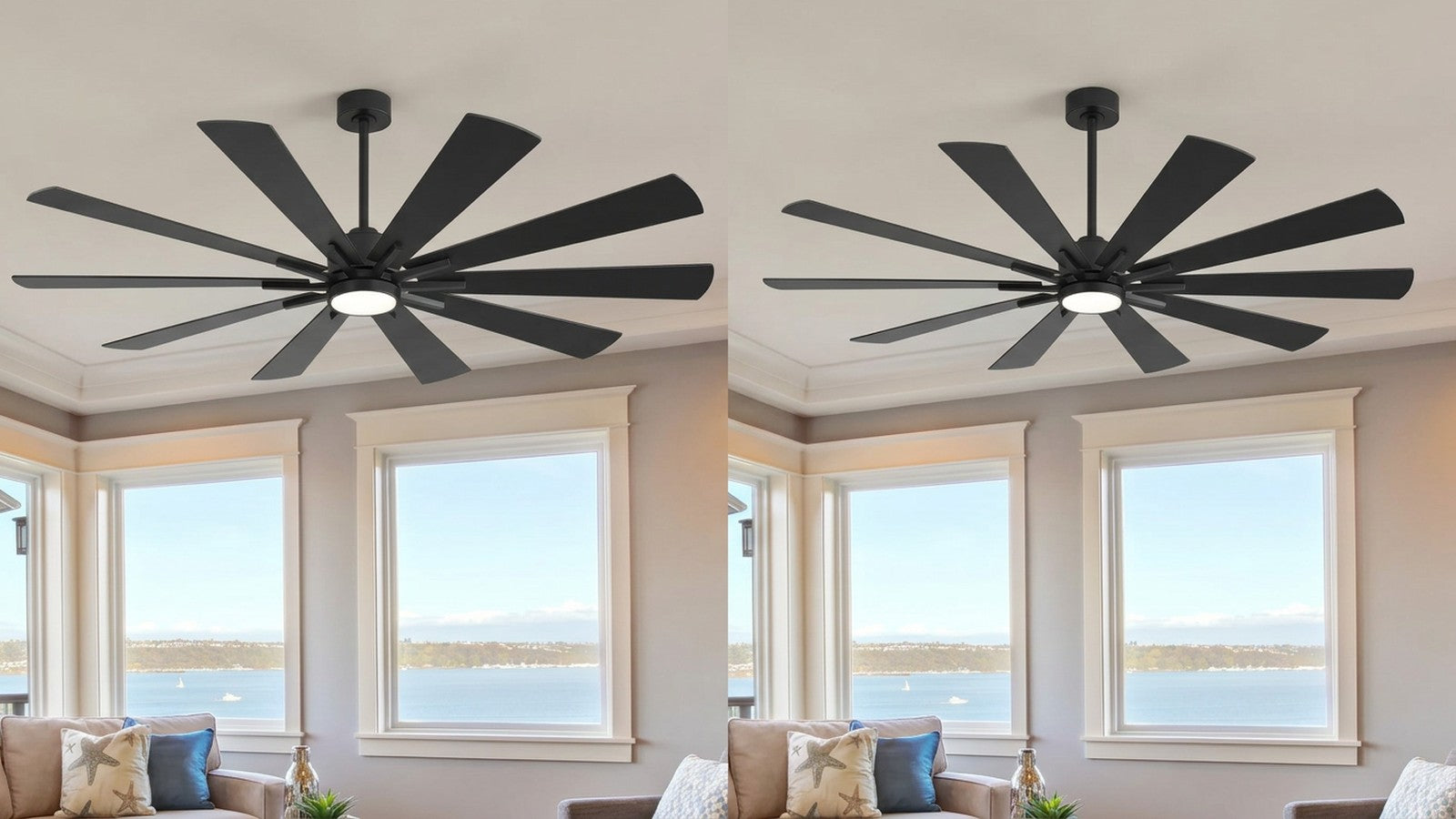
View the available configurations of the Breezary 62/72-Inch Large Ceiling Fan with Light .
Compare fans intended for taller spaces: Large Ceiling Fans for High Ceilings .
Estimate an appropriate downrod configuration: Ceiling Fan Downrod Length Calculator .
BLADE COUNT AND AIRFLOW
Are More Fan Blades Better for Cooling?
More fan blades do not automatically mean more airflow or better cooling. Blade count is only one part of the complete fan design. Motor performance, blade pitch, blade profile, rotational speed and the relationship between all these components also affect how a ceiling fan moves air.
A fan with three, four, five, six, eight or ten blades should not be judged by blade quantity alone. Additional blades may change the fan’s appearance and aerodynamic loading, but they do not independently establish higher CFM.
When published airflow data are available, compare the model-specific CFM figure alongside fan diameter, motor information, speed range and installation requirements.
SAME SPAN, DIFFERENT BLADE COUNTS
Comparing Item #40026-L and Item #40044
Breezary Item #40026-L and Item #40044 are both documented as 60-inch ceiling fans, but one uses six blades and the other uses ten. Their manuals do not publish comparable CFM data, so blade count alone cannot establish which model moves more air.
| Model | Blade Span | Blade Count | Approximate Installed Height |
|---|---|---|---|
| 40026-L | 60 in. | 6 | Approximately 14.25 / 20.15 in. |
| 40044 | 60 in. | 10 | Approximately 14 / 20 in. |
View Item #40026-L: Breezary 60-Inch Ceiling Fan with LED Light .
Item #40044 is included as a manual-based comparison only. No product link is added because a confirmed live product page is not currently available.
LARGE FAN SELECTION CHECKLIST
What Performance Specifications Should You Compare?
Do not compare large ceiling fans by diameter, price or blade count alone. A useful comparison should connect room layout, airflow information, installation dimensions, functions and current purchasing conditions.
Room and Coverage
- Room square footage: Use it as a starting reference, not the only sizing factor.
- Room shape: Identify whether the space is square, long, L-shaped, open or divided.
- Occupied zones: Determine where people sit, work, dine or spend the most time.
- Blade span: Confirm the complete rotating diameter and available horizontal clearance.
Airflow and Operating Performance
- Published CFM: Compare airflow volume only when a figure is published for the specific model.
- Speed range: Check the available number of operating speeds and control options.
- Low-speed operation: Consider whether the fan provides an appropriate lower setting for the intended occupied zone.
- Motor information: Review the model-specific motor type and documented operating functions without assuming performance from the motor label alone.
Installation Dimensions and Compatibility
- Overall installed height: Measure from the ceiling to the lowest point of the complete fan.
- Blade-plane height: Confirm where the blades will sit relative to the floor and occupied zone.
- Included downrods: Check which lengths are supplied with the specific model.
- Sloped-ceiling compatibility: Verify the supported slope and any model-specific installation requirements.
Functions, Location and Purchasing Details
- Light: Determine whether the room requires an integrated light and review the documented lighting functions.
- Control: Compare remote, wall-control and supported fan or light functions.
- Indoor or outdoor rating: Use only a fan documented for the intended installation environment.
- Warranty: Review the current model-specific warranty terms and coverage.
- Current inventory: Confirm present availability, finish, quantity, price, delivery and lead time on the applicable product listing.
The most suitable large ceiling fan is the model whose airflow, physical dimensions and installation configuration match the room—not simply the fan with the widest span or the most blades.
MODEL-SPECIFIC AIRFLOW EXAMPLE
A Breezary Large-Fan Example With Published Airflow
This is a model-specific performance-data example, not a product ranking. It shows why published airflow and installation specifications are more useful than assuming performance from fan diameter or blade count alone.

Breezary Item #23012-AB-NL
Breezary Item #23012-AB-NL is a 65-inch, eight-blade indoor ceiling fan without a light. Its current product page publishes airflow up to 9,422 CFM and documents six speeds, forward/reverse operation, remote control, and 7-inch and 12-inch downrods. It is a useful example of why buyers should compare published airflow and installation specifications rather than assuming performance from diameter alone.
| Product Specification | Item #23012-AB-NL |
|---|---|
| Blade span | 65 inches |
| Blades | 8 ABS blades |
| Intended location | Indoor use |
| Light | No light |
| Motor | DC motor |
| Speed settings | 6 speeds |
| Control | Remote control |
| Direction | Forward/reverse operation |
| Included downrods | 7-inch and 12-inch downrods |
| Current published airflow | Up to 9,422 CFM |
Review current model details: Breezary 65-Inch Ceiling Fan for Large Rooms .
The 9,422 CFM figure is published for Item #23012-AB-NL on its current product page. It should not be generalized to every 65-inch fan or used to claim that this model is automatically stronger than a 72-inch fan.
FACTORY DIRECT • SINGLE-UNIT & SMALL-BATCH SUPPORT
Factory-Direct Options for One Fan or a Multi-Room Project
Breezary supports individual online purchases as well as discussions for coordinated, small-batch and multi-room orders. Product specifications, current pricing, inventory, delivery and lead time should always be confirmed for the applicable model and order quantity.
Buy One Available Fan Online
A currently available ceiling fan can be purchased individually through the standard Breezary online checkout process.
- Confirm the specifications on the applicable product page.
- Review current pricing and available finish options.
- Check current inventory before placing the order.
- Confirm shipping availability and delivery information for the destination.
Factory-direct availability does not mean that every model is always in stock or that factory-direct pricing is always lower.
Discuss a Small-Batch or Multi-Room Order
Small-batch discussions may be useful when several fans are needed for:
- Multiple large rooms
- Open-plan projects
- Hotels and hospitality spaces
- Restaurants
- Showrooms
- Property projects
- Small commercial spaces
For project quantities, compare the required fan span, published specifications, mounting height, lighting and controls for each space before selecting a single model for the entire project.
LARGE CEILING FAN FAQ


