Key takeaways
- Fans move dust; they don't make it. Clean blades and a low starting speed limit what a fan stirs up.
- Fans can help a purifier. A 2025 multiroom study found fans plus a room air cleaner removed particles faster than the cleaner alone.
- HVAC still wins for larger particles. A 2023 study found continuous HVAC operation did better for 1–5 µm particles.
- Source control comes first. EPA says filtration doesn't replace controlling pollutants and ventilating.
Do Ceiling Fans Make Dust and Allergies Worse?
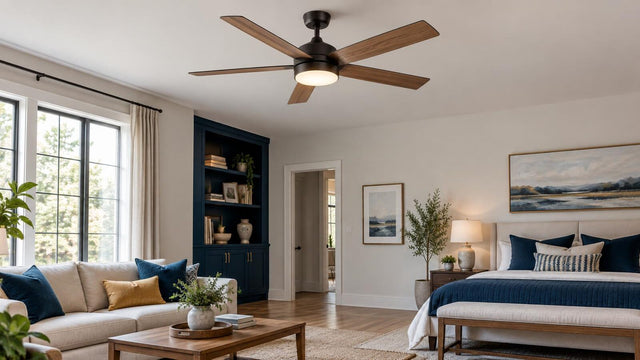
A ceiling fan doesn't create dust or allergens, but it moves air, so a dusty fan can shed dust when it starts and stir up what's already in the room. Clean blades and sensible speeds matter more than whether the fan runs.
The everyday problem is the fan itself. Dust builds up on the top of the blades while the fan sits idle, and some of it comes loose when the blades start turning. The fix is simple: keep the blades clean and start on a low speed.
The Asthma and Allergy Foundation of America (AAFA) notes that dusting and vacuuming also stir up dust. On its dust mite allergy page, it recommends:
- Vacuuming weekly with a vacuum that has a HEPA filter.
- Keeping indoor humidity between 30% and 50%.
- Having someone without the allergy do the cleaning, or wearing an N95 mask while cleaning.
- Using a freestanding air cleaner in the bedroom, because it only filters a limited area.
A ceiling fan has no filter and is not an air-cleaning device. If allergy or asthma symptoms are the concern, the right person to ask is your doctor; this guide covers how the fan fits in.
Should You Run a Ceiling Fan With an Air Purifier?
Research suggests it helps. In a 2025 study, running ceiling fans with a room air cleaner removed particles faster than the air cleaner alone, and faster than the two would add up to separately.
The study, "Impact of ceiling fan and room air cleaner on air mixing and fate of particulate matter in a multiroom residence," was published in Science and Technology for the Built Environment in 2025 by Daniel Rush, Mengjia Tang and Atila Novoselac, in work involving Oak Ridge National Laboratory. The team released tracer gas and particles from ultrafine to 5 µm in the kitchen of a multiroom test house and measured how quickly they were removed under different combinations of ceiling fans and a room air cleaner.
What the authors reported:
- Ceiling fan mixing alone increased removal of ultrafine particles and particles larger than 1 µm compared with no fans and no air cleaner, which they attribute to more particles settling onto fan blades and house surfaces.
- With the air cleaner running, adding ceiling fan mixing increased particle removal in every size range they measured.
- The fans and air cleaner together removed particles faster than the sum of each running alone, which the authors describe as the fans increasing the air cleaner's filtration rate.
- They concluded that whole-house mixing by ceiling fans may improve air cleaner performance in multiroom homes, with a minor increase in energy use.
We don't quote removal percentages here, because results from one test house won't translate directly to your home. The direction of the finding is the useful part: a running fan helps bring room air to the purifier.
How Do Ceiling Fans Move Particles Between Rooms?
A portable air cleaner mostly cleans the air near it. Ceiling fans mix the air in each room, and through open doorways that mixing carries more of the home's air past the cleaner.
The 2025 study starts from that problem: room air cleaners "are often limited to treating local air in the room or near vicinity of the device." AAFA makes the same point for freestanding units. The test house used fans running through the house, with particles released in the kitchen, so it reflects open, connected rooms. A fan won't push meaningful air through a closed door, so if the purifier is in a closed bedroom, the fan in the hallway mainly helps the hallway.
Ceiling Fan and Air Purifier vs Running the HVAC Fan
Each wins on something. An earlier study by the same team found running the HVAC fan continuously did better for larger particles, while one ceiling fan and air cleaner combination did slightly better for ultrafine particles and used much less energy.
That 2023 paper, "Comparing HVAC Fan Operation with a Ceiling Fan and Room Air Cleaner Combination for Indoor Air Quality, Thermal Comfort, and Energy Use in a Multizone Residence," appeared in ASHRAE Transactions. Its authors reported that continuous HVAC operation outperformed the portable air cleaner in all configurations for particles of 1–2.5 µm and 2.5–5 µm, and called for more testing of fan and air cleaner combinations.
| Approach | What the sources report | Keep in mind |
|---|---|---|
| Ceiling fan + portable air cleaner | Fans increased the cleaner's particle removal (2025); one combination edged out HVAC for ultrafine particles with much less energy (2023) | Works best with open doors; size the cleaner by CADR |
| HVAC fan running continuously | Outperformed the portable cleaner for 1–2.5 µm and 2.5–5 µm particles (2023) | EPA notes furnace and HVAC filters only filter while the system is running |
| Ceiling fan alone | Mixing increased removal of some particle sizes, likely by deposition on blades and surfaces (2025) | No filter; settled dust stays in the house until you clean it |
AAFA's dust mite page also suggests a Certified Asthma & Allergy Friendly filter for a central furnace and air conditioner as a whole-home option.
Does Dust on Ceiling Fan Blades Affect Indoor Air?
Blade dust is dust the room has already deposited. Left in place, it can come loose when the fan starts, so cleaning the blades regularly keeps it from going back into the air.
The 2025 study's explanation for better particle removal with fans running, more particles depositing on fan blades and house surfaces, is also a reminder that those surfaces collect what the air carries. Large fans have more blade area, so the dust line shows sooner.
- Clean on sight: when you see a gray line on the blade edges, it's time.
- Damp, not dry, for allergies: a barely damp microfiber cloth holds dust instead of flicking it into the air.
- Power off: clean with the fan and light off and the light cool.
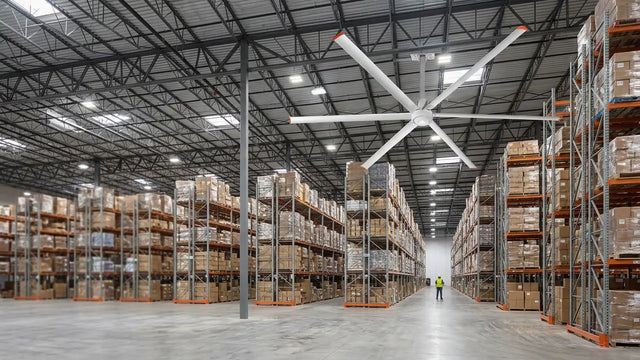
For step-by-step methods, see how to clean a ceiling fan without damaging the finish, or how to clean enclosed and caged fans if your blades sit inside a frame. Industrial dust is a different problem; our article on whether HVLS fans stir up dust covers warehouses and shops.
How to Set Up a Ceiling Fan and Air Purifier in a Bedroom
Size the purifier to the room, place it where you spend time, keep doors open if you want the effect to reach other rooms, and run the ceiling fan on a low speed.
- Choose the purifier by CADR. EPA's Guide to Air Cleaners in the Home (2018) says to choose a clean air delivery rate large enough for the room, and notes higher ceilings may call for a higher CADR.
- Place it well. EPA suggests the room you spend the most time in, away from curtains and anything that blocks airflow.
- Run the fan low. A low speed keeps air moving without a strong draft. DC fans with several speeds make this easier: the Selen 60/72 Inch 8-Blade Ceiling Fan lists six speeds and running noise under 35 dB, and the Aerovia 52-Inch Smart Ceiling Fan lists six speeds and a Natural Wind mode.
- Try reverse for gentle mixing. Both models have a reversible motor; reverse moves air up and along the ceiling instead of blowing straight down.
- Keep the basics. EPA puts reducing pollutant sources and ventilating ahead of filtration: "Filtration does not replace the need to control pollutants and ventilate."
For quiet, bedroom-friendly models, see our roundup of the best ceiling fans with lights.
Looking for a quiet fan to run alongside a purifier?
View Bedroom Ceiling FansCeiling Fans, Dust and Allergies FAQ
Should I run my ceiling fan with an air purifier?
Research suggests it can help. In a 2025 study involving researchers at Oak Ridge National Laboratory, running ceiling fans with a room air cleaner in a multiroom test house removed particles faster than the air cleaner alone. It was one test house, so treat it as a promising finding rather than a guarantee.
Do ceiling fans make allergies worse?
A fan doesn't create allergens, but it moves air, and a dusty fan can shed dust when it starts. Keep the blades clean, start on a low speed, and follow allergy-control basics such as weekly HEPA vacuuming. For medical questions, talk to your doctor.
Is it better to run the HVAC fan or a ceiling fan with a purifier?
It depends on particle size and energy use. A 2023 study from the same Oak Ridge team found continuous HVAC fan operation did better for larger particles, while one ceiling fan and air cleaner combination did slightly better for ultrafine particles and used much less energy.
Where should I put an air purifier in a room with a ceiling fan?
EPA suggests placing a portable air cleaner in the room you spend the most time in and keeping it away from curtains and anything that blocks airflow. Choose one with a clean air delivery rate (CADR) large enough for the room.
How often should I clean ceiling fan blades if I have allergies?
There is no set schedule in the research. Clean whenever you see a dust line on the blade edges, and more often during heavy use. Dust with a damp microfiber cloth so less dust goes airborne, and if possible have someone without allergies do it.