Key takeaways
- Slope limits are per model. Breezary large residential fans list 10° to 15°; the 12-foot HVLS fan lists 20°.
- Measure in degrees. Rise over a 24-inch level, divided by 2, gives the pitch; 3/12 is about 14° and 4/12 about 18.4°.
- A longer rod is not a steeper rating. It adds blade clearance, but the canopy and ball angle limit stays the same.
- Box and framing first. Use a box listed and marked for fan support, flush with the ceiling, and have an electrician confirm it.
Can Every Large Ceiling Fan Be Installed on a Vaulted Ceiling?
No. A fan can go on a vaulted or sloped ceiling only if its mount is rated for that angle, and the rating is set model by model. Breezary's large residential fans list maximum slopes of 10 to 15 degrees; our 12-foot HVLS fan lists 20 degrees.
Two lines on the product page settle the question: the mounting type, which says whether an angled mount is offered, and the sloped-ceiling limit, which says how steep it can go. If either line is missing, or they seem to disagree, ask before you buy. A flush-mount fan is a different case, and our flush mount vs standard fan guide covers whether one can go on a slope.
| Model | Size | Mounting listed | Max slope listed | Downrods (product page) |
|---|---|---|---|---|
| Raven 62/72 Inch 10-Blade | 62 or 72 in | Angled, downrod | 15° (72-inch) | 6 and 12 in, 5.9-in canopy |
| Fenora 72 Inch Indoor | 72 in | Downrod, angled | 15° | 6, 12 and 24 in |
| Nerova 72-Inch Black Wood | 72 in | Downrod, angled | 14° | 6 and 20 in |
| AeroSpan 84" 8-Blade with Light | 84 in | Downrod, angled | 14° | 6, 12 and 24 in |
| AeroSpan XL 96–108" | 96, 100 or 108 in | Angled, downrod | 14° | Differs by SKU |
| Jovora 72" Large Black | 72 in | Angled, downrod | 12° | 6 and 10 in |
| Aviora 60-Inch Black and Wood | 60 in | Downrod | 10° | 9.8 in |
| Austerra 120" Industrial | 120 in | Downrod | Not listed | Three lengths |
| AeroVault 12FT HVLS | 144 in | Angled, downrod | 20° | Not stated; certified electrician installs |
Two things stand out. First, a 15-degree limit is common, but not universal: Jovora stops at 12 and Aviora at 10. Second, a large fan with no slope figure, like Austerra, should be treated as a flat-ceiling fan until the manual or customer service says otherwise.
How Do You Measure the Slope of a Vaulted Ceiling Before Buying a Fan?
Measure the ceiling surface itself, at the spot where the fan will hang, and convert it to degrees. Fan ratings are given in degrees, while ceilings are usually described as a pitch such as 4/12.
- Hold a 24-inch level against the ceiling, one end touching, and level it.
- Measure straight up from the free end of the level to the ceiling. That is the rise over 24 inches.
- Divide by 2 to get the rise per 12 inches, then use the table below. A digital angle finder held against the ceiling gives degrees directly.
Measure the finished ceiling, not the roof. Scissor trusses and framed-in ceilings often have a lower pitch than the roof above them.
| Pitch (rise per 12 in) | Angle | Fits a 15° rated Breezary fan? |
|---|---|---|
| 2/12 | 9.5° | Yes, and also a 10° model |
| 2.5/12 | 11.8° | Yes; 12° models too |
| 3/12 | 14.0° | Yes; right at the limit of 14° models |
| 4/12 | 18.4° | No |
| 6/12 | 26.6° | No |
| 12/12 | 45.0° | No |
When Does a Vaulted Ceiling Need a Sloped-Ceiling Adapter?
On a Breezary angled-mount model, the listed slope is what the fan's own bracket, canopy and downrod ball are rated for. Within that angle you hang it with the parts in the box. Past it, there is no Breezary adapter to buy.
Product pages describe this directly: Fenora's mount "suits" slopes up to 15 degrees, and Raven's "mount and two downrod lengths" handle up to a 15-degree pitch. Our catalog does not list a separate sloped-ceiling adapter.
Are sloped-ceiling adapters universal?
No. Adapters sold by other brands are built around their own hanger brackets, canopies and downrod sizes, and their angle limits vary widely. Hunter's angled-mount guidance (checked 2026), for example, says its fans typically need an adapter above about 34 degrees. That number says nothing about a Breezary fan. Only use an adapter the fan's manufacturer approves for that model.
Does the adapter or rod have to match the downrod diameter?
Yes. The rod, ball, pin and canopy opening all have to fit together. Breezary's 24 to 72-inch extension downrods list a 23.5 mm inner and 26.5 mm outer diameter, and the custom rods ship without the upper ball. Our downrod length calculator covers rod length and the full compatibility checklist.
What If the Ceiling Is Steeper Than the Fan's Rated Angle?
Don't hang it there. A ball pushed past its rated angle can bind against the canopy, keep the fan from hanging plumb and lead to wobble or a fan that is not properly seated.
- Pick a model with a higher rating if your ceiling is only slightly over the limit, for example 3/12 with a 12° fan in mind.
- Ask a contractor about a level mounting surface. A qualified carpenter or electrician can build a framed block that presents a flat, level face for the box. Whether that suits your ceiling is their call, not a DIY guess.
- Move the fan to a flatter part of the ceiling, such as a flat section beside a vault.
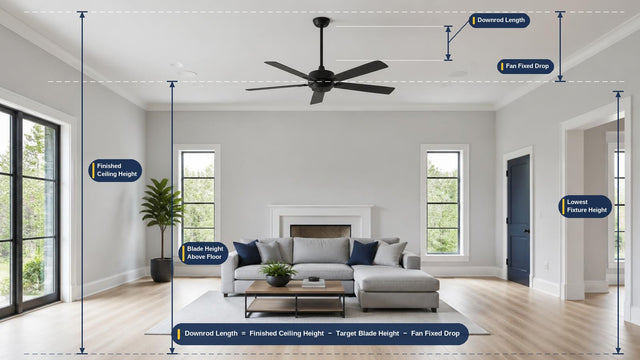
A longer downrod does not raise the slope rating. It does help with blade clearance: the Velelle 60 Inch and Verara 52-Inch product pages both note that a longer rod may be needed on steeper slopes to keep the blades clear.
Should the Fan Go at the Peak or on One Side of the Slope?
Center the fan over the seating area if you can, then check two things: blade clearance to the low side of the ceiling and solid framing at that exact spot. The peak gives the most even clearance, but the structure decides.
Mounting at the peak or on a ridge beam
At the peak, the box usually lands on or beside a ridge board or beam. Ask an electrician to confirm three things: that the box or bracket is listed for fan support, that it is fastened to framing that can carry the fan, and that the box face sits flush with the finished ceiling. Some peaks need a framed block between the rafters to give the box something solid to bear on.
Can rafters push the fan off center?
Yes. The box has to land on framing, and a rafter or ridge can sit a few inches from where the fan looks centered. Fan braces that span between framing members give some room to shift. In new construction or a remodel, plan the fan location and blocking before the drywall goes up, while the framing is open.
What Electrical Box Does a Vaulted-Ceiling Fan Need?
A box listed and marked for fan support, solidly attached to the structure. Under section 314.27(C) of the National Electrical Code (2023 edition), a box used as the sole support for a ceiling fan must be listed and marked for that use and may not carry a fan over 70 lb.
The same section requires boxes made for fans over 35 lb to be marked with the maximum weight. For scale, the AeroSpan XL 96–108" lists net weights from 30 lb to 35 lb depending on size. Some fans ask for more than a box: the AeroVault 12FT HVLS requires installation by a certified electrician, and the AeroSpan 84" with light recommends a qualified licensed electrician and blades at least 10 ft above the floor.
What if the existing box is at the wrong angle?
The box face should follow the ceiling surface. If it is twisted, recessed or tilted, the bracket sits crooked and the canopy will not close against the ceiling. Have the box reset or replaced rather than shimming the canopy. Wiring itself is covered in how to wire a ceiling fan with light; leave the box and framing to an electrician.
How Do You Keep a Large Fan Level on a Sloped Ceiling?
The fan stays level because the downrod hangs plumb from a ball joint in the bracket. Your job is to set the bracket the way the manual shows, seat the ball's slot on the bracket tab, and confirm the canopy and receiver fit.
- Bracket direction. Instructions differ between manufacturers. Some say the bracket opening faces the high side of the slope; others orient it along the slope. Follow the diagram in your fan's manual.
- Canopy fit. The canopy tilts with the ceiling while the rod stays vertical. If the rod touches the edge of the canopy opening, the ceiling is too steep for that mount.
- Receiver space. Remote fans hide a receiver in the bracket or canopy. On the Koren 72-Inch, the product page says the receiver sits in the mounting bracket. On a slope there is less room, so make sure wires and the receiver fit without pinching before you close the canopy.
- Blade height. Follow the model's minimum: Nerova asks for at least 7.5 ft from blades to floor.
If the fan wobbles after installation, the angled-ceiling checks in how to balance a wobbling ceiling fan are the next step.
Have your ceiling angle in degrees?
View fans for vaulted ceilingsVaulted Ceiling Fan Installation FAQ
Can I put any large ceiling fan on a vaulted ceiling?
No. Only models with a listed sloped-ceiling rating should go on an angled ceiling. Breezary large residential fans list limits between 10 and 15 degrees, and a few, such as the Austerra 120-inch, list no slope rating at all. Measure your ceiling and compare it with the exact model before you buy.
How steep can a ceiling be for a Breezary fan?
It depends on the model. Raven 72-inch and Fenora 72-inch list 15 degrees, Nerova 72-inch and the AeroSpan 84-inch with light list 14 degrees, and Jovora 72-inch lists 12 degrees. The AeroVault 12-foot HVLS fan lists 20 degrees and requires installation by a certified electrician.
Is a 4/12 ceiling too steep for a ceiling fan?
A 4/12 pitch is about 18.4 degrees. That is steeper than the listed limit of every large residential Breezary fan (the 20° rating belongs to the HVLS models), so it would need a different mounting approach approved by the manufacturer or a level mounting surface built by a qualified contractor.
Does a longer downrod let a fan hang on a steeper ceiling?
No. A longer downrod lowers the blades and adds clearance from the ceiling, but it does not change the angle the canopy and ball joint can handle. The slope rating stays the same whatever rod length you use.
Do I need an electrician to install a fan on a vaulted ceiling?
A licensed electrician should confirm the box, the framing behind it and the wiring, especially at a ridge or on a box that was installed at the wrong angle. Some large models, such as the AeroSpan 84-inch with light, recommend a qualified licensed electrician on the product page.