Key takeaways
- Wicker is a method, rattan is a material. A wicker weave can be rattan, reed, paper rope or plastic resin.
- "Rattan-style" describes a look. Breezary's Halcyra lists a metal body, ABS blades and a PMMA shade, and does not name the fiber in its woven cage.
- Check shade and blade materials separately. A natural-looking shade or blade finish does not mean the rest of the fan is natural.
- Location rating beats material look. Use the listed indoor or covered outdoor rating and clean woven shades dry and gently.
What Is the Difference Between Rattan, Wicker and Bamboo?
Rattan and bamboo are materials. Wicker is a way of weaving. A wicker ceiling fan shade can be woven from rattan, but it can just as easily be paper rope, reed or plastic resin.
That is why the three words cause so much confusion on boho ceiling fans. They describe different things, and a product photo can only show you one of them clearly: the weave.
- Rattan is the stem of a climbing palm. It is solid, flexible when steamed and strong enough to bend into frames. Its thin outer skin, often called cane, is used for fine weaving.
- Wicker is the technique of weaving flexible strands over and under a frame. The strands can be natural or synthetic.
- Bamboo is a grass with hollow, jointed stems. It is stiff rather than bendy, so it shows up as poles, slats, split strips or pressed boards.
| Term | Material or method? | Typical look | Clues |
|---|---|---|---|
| Rattan | Material | Round strands or wrapped frames in honey tones | Slight variation in strand width and color |
| Wicker | Method | Basket-style over-under weave | Tells you nothing about the fiber on its own |
| Bamboo | Material | Jointed poles, flat slats or woven split strips | Nodes along the stem, straight grain |
| Paper rope or resin | Material | Very even wicker weave | Uniform color and strand size, slight sheen on resin |
Is a Woven Ceiling Fan Shade Real Rattan?
Not necessarily. Read the material fields and the description wording; a listing that says "rattan-style" is describing a look, not confirming the fiber.
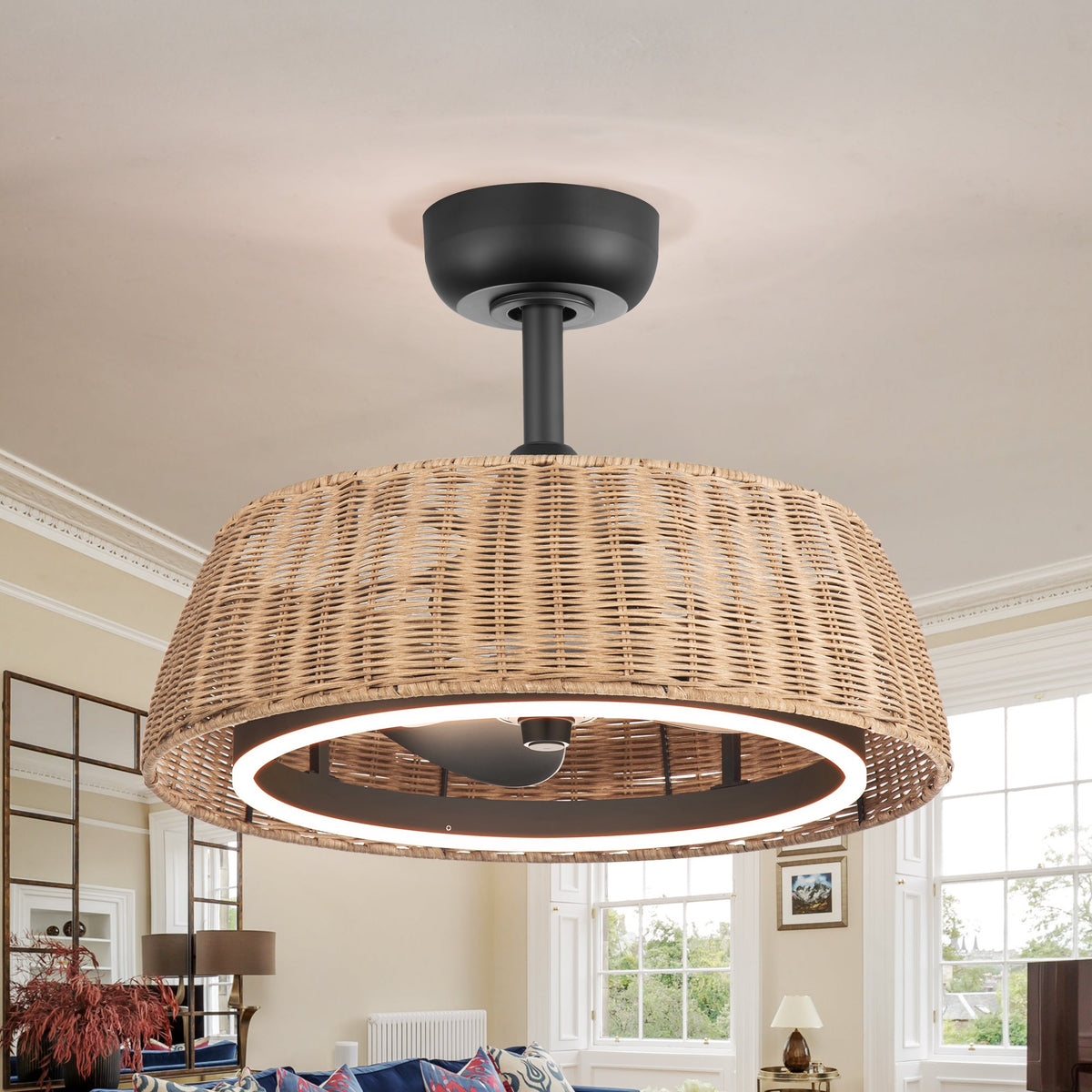
Breezary's Halcyra 20-Inch Boho Rattan Ceiling Fan With Light is a good example of how to read a listing. The description calls it a rattan-style ceiling fan with a woven cage and a rattan-style weave. The spec sheet lists a metal body, ABS blades and a PMMA shade, which is the acrylic diffuser over the LED. It does not name the fiber used in the woven cage.
So the honest way to describe Halcyra is a rattan look on a metal-bodied fan. If natural rattan is important to you, for example because you want to match a natural rattan chair, ask customer service before ordering: 707-249-3725 or support@breezary.com.
Clues that a weave may be natural fiber
- Strands vary slightly in width, and the color shifts from strand to strand.
- Cut ends show fibers rather than a smooth plastic edge.
- Small marks, joints or knots appear at irregular intervals.
Clues that a weave may be synthetic
- Perfectly even color and strand width across the whole shade.
- A slight plastic sheen, especially under direct light.
- A pattern that repeats without any irregularity.
These clues are hints, not proof. Good synthetic weaves can look very natural in photos. The material field, the description and the manufacturer are the evidence. The same rule applies to wood: our guide to oak ceiling fans explains real wood versus wood-grain finishes.
Where Does the Material Show Up: Shade, Cage or Blades?
On most boho fans the woven part is the shade or cage around the light. The blades are usually plywood, MDF, ABS or solid wood, so check both fields.
The spec list separates shade material and blade material for a reason. A natural look in one place does not carry over to the other. Here is how four Breezary fans with natural-looking details actually list their materials:
| Model | Natural-looking detail | Listed blade material | Listed shade material |
|---|---|---|---|
| Halcyra 20-Inch Boho Rattan | Rattan-style woven cage | ABS | PMMA |
| Velelle 60 Inch Ceiling Fan | Paulownia blades in a walnut finish | Solid wood | Acrylic |
| 54 Inch 5 Blade Palm Leaf Ceiling Fan | Walnut-finish blades | ABS | Acrylic |
| Galara 65 Inch Caged Ceiling Fan | Reversible black and walnut-look blades | MDF | Not listed (open metal cage) |
Only Velelle lists a natural material, solid paulownia wood, for its blades. The palm leaf fan and Galara get their warm wood tone from a finish on ABS and MDF. That is not a flaw; it is just a different thing from real wood or real fiber, and it is worth knowing before you pair a fan with natural furniture.
A woven cage also changes how the fan works. Halcyra's blades sit inside the cage, which makes it read like a decorative light more than a wide-blade fan. Our guide to fandeliers versus caged and enclosed fans explains what that means for airflow and room size.
Are Bamboo Ceiling Fans Made of Real Bamboo?
Some fans use engineered bamboo blades, and some use bamboo-look finishes or woven shades. Only the material listing tells you which.
Engineered bamboo blades are made by pressing and gluing bamboo strips into flat boards, which are then cut and shaped. That is a different product from a woven bamboo shade, and both are different from a printed bamboo pattern on plastic or wood.
None of the fans in Breezary's current catalog lists bamboo as a blade or shade material. If you are shopping specifically for bamboo, look for "bamboo" in the blade or shade material field itself, not only in the product name or style tags.
How Does a Woven Shade Change the Light?
A woven shade softens the light and can throw a basket-weave pattern onto the ceiling and walls. Tighter weaves block more light; open weaves cast stronger patterns.
That pattern is part of the appeal of a boho fan, but it helps to know where the light source sits. On Halcyra, the integrated LED is a ring at the bottom edge of the woven cage, so most of the light goes downward and the weave is lit from below. The LED is dimmable from the remote and listed at a warm white 2700K-3000K, a color range that suits natural textures. The listing warns not to use a wall dimmer or rheostat with it.
Natural fibers also vary in tone from piece to piece and can darken or fade with years of light exposure. If you are matching a fan to existing rattan furniture, expect close rather than identical color, whichever material the fan uses.
Are Color and Weave Differences in a Rattan Fan Normal?
Some are. Hand-woven natural fiber varies in tone, strand width and tightness, and shows joins where one strand ends and the next begins. Broken strands, loose ends and a weave pulling away from its frame are not normal and are worth reporting.
What Is Normal in a Natural Weave
- Slight color differences from strand to strand, or between two fans of the same model.
- Small joins, nodes or knots at irregular intervals.
- Small differences in weave tightness across the shade or cage.
What to Report
- Strands that are broken, cracked through or sticking out.
- A weave that is unraveling, sagging or coming away from its frame.
- A loose cage, frame or fastener, or anything touching the blades.
- Mold spots or a musty smell.
If anything touches the blades, turn the fan off. Photograph the problem in good light and contact customer service at 707-249-3725 or support@breezary.com with your order and model.
The Halcyra 20-Inch Boho Rattan Ceiling Fan With Light is a useful reminder to check the listing first. It describes a rattan-style weave and doesn't name the fiber, so don't assume it will show the variation of hand-woven natural rattan. Ask customer service if that matters to you.
Why a Rattan Fan Can Look Different From the Photos
Product photos are taken under studio lighting and shown on screens with their own color settings, and woven textures change more with light than smooth finishes do. A weave that looks honey-colored in a bright photo can look deeper under warm bulbs, and on Halcyra the pattern looks stronger at night, when the LED ring lights the weave from below.
Can Woven Ceiling Fans Handle Humidity, and How Do You Clean Them?
Go by the fan's listed use location, not by the material look, and clean a woven shade gently and dry.
Natural fibers can swell, sag or grow mildew in damp air and turn brittle in very dry heat, while synthetic resin generally holds up better. That is why the location rating on the product page and in the manual matters more than how natural the shade looks. Halcyra's spec sheet lists indoor and covered outdoor use; confirm that rating on the product page or in the manual for your exact space. For porches near the ocean, see our guide to coastal ceiling fans and salt air.
For routine care, turn the fan and light off at the wall, let the LED cool, and remove dust with a soft brush or a vacuum brush attachment. Avoid soaking a woven shade or spraying cleaner directly onto it. For step-by-step help with cages and enclosed designs, see how to clean enclosed and caged ceiling fans.
Looking for a woven or natural-look fan?
View boho ceiling fans with lightsRattan, Wicker and Bamboo Ceiling Fan FAQ
Is wicker the same as rattan?
No. Rattan is a material, the stem of a climbing palm. Wicker is a weaving method. Wicker can be made from rattan, but also from willow, reed, paper rope or plastic resin, so a wicker shade is not automatically rattan.
Is the Halcyra boho rattan ceiling fan made of real rattan?
Breezary's listing describes it as a rattan-style weave and does not name the fiber used in the cage. Its listed materials are a metal body, ABS blades and a PMMA light shade. If natural rattan matters to you, contact Breezary customer service at 707-249-3725 or support@breezary.com before ordering.
How can I tell real bamboo from a bamboo look?
Real bamboo shows nodes, the raised rings along the stem, and slight color variation along its length. Bamboo-look parts usually have a printed or molded pattern that repeats evenly. The material field in the product specs is the best evidence.
What is paper rope wicker?
Paper rope is tightly twisted paper fiber woven in a wicker pattern. It looks smooth and even, takes stain and paint well, and is lighter than rattan, but it does not handle moisture as well as many other materials.
Does a woven shade make a ceiling fan light dimmer?
It can. A tight weave blocks more light and throws a stronger pattern, while an open weave lets more light through. Where the light sits relative to the weave also matters, so check the photos of the fixture lit.
Are woven ceiling fans a good choice for a bedroom?
They can be, if the size fits. The Halcyra 20-inch fan is listed for small and medium rooms, has a dimmable warm white LED (2700K-3000K) and a 14W DC motor with six speeds.