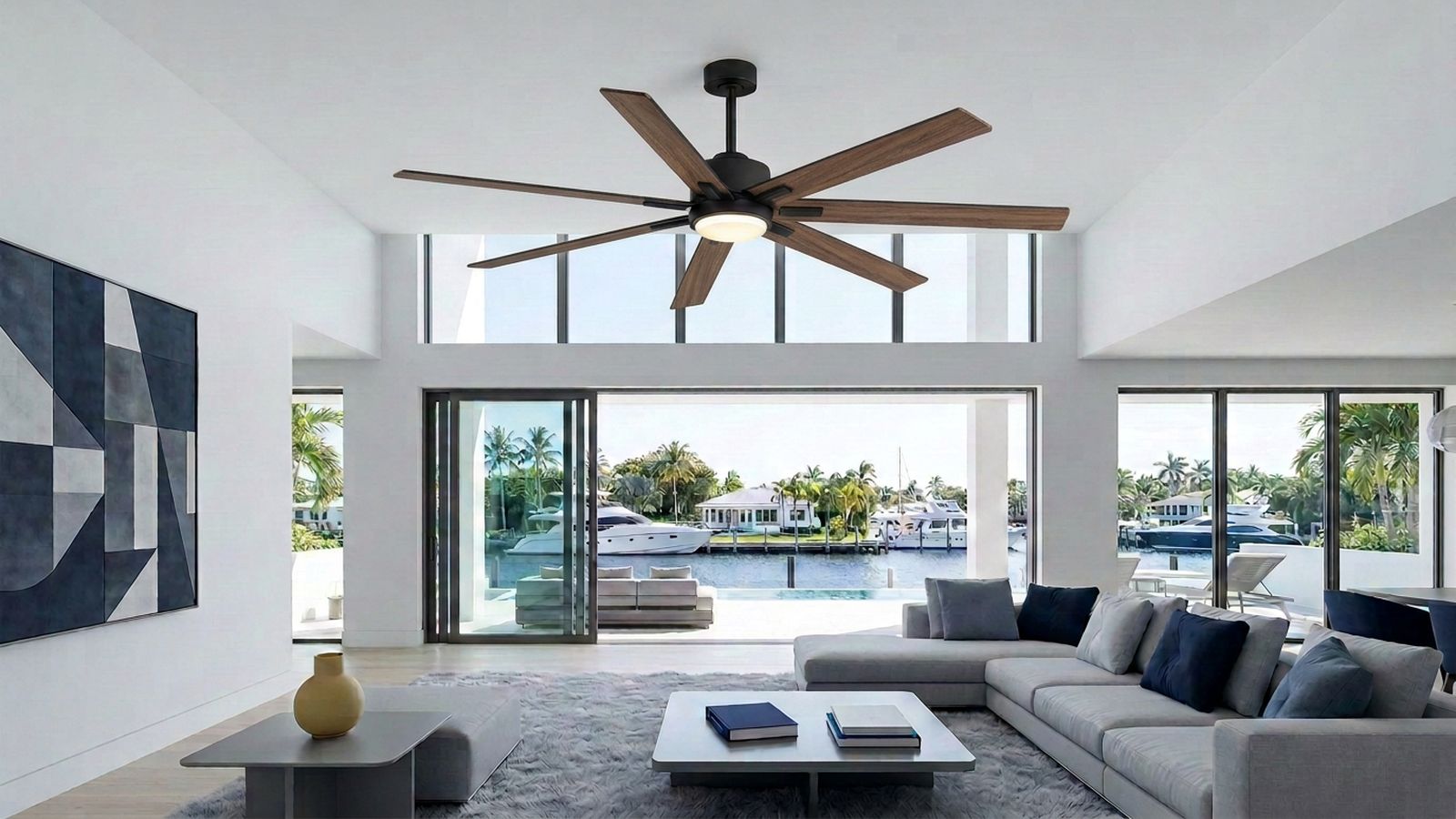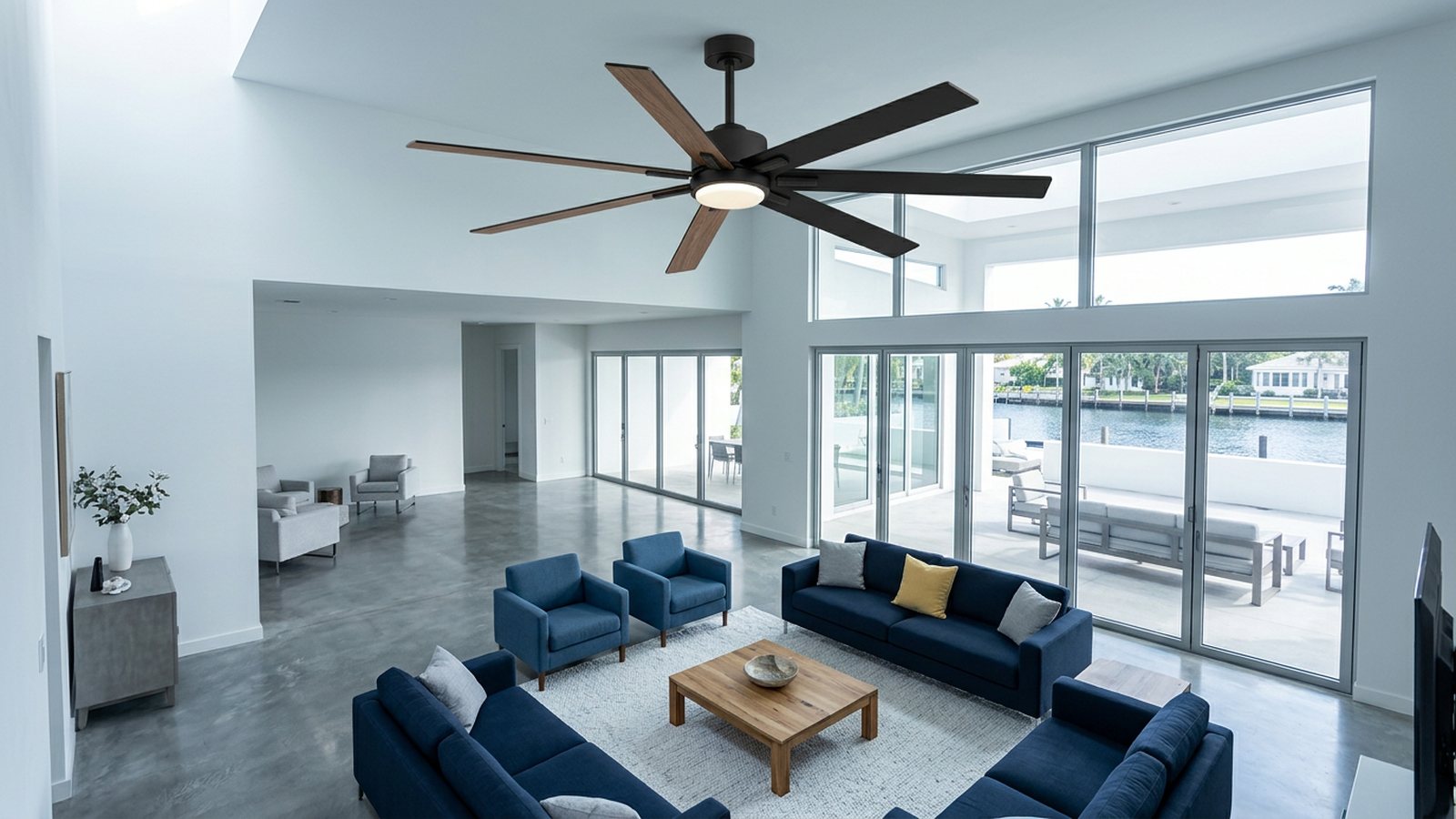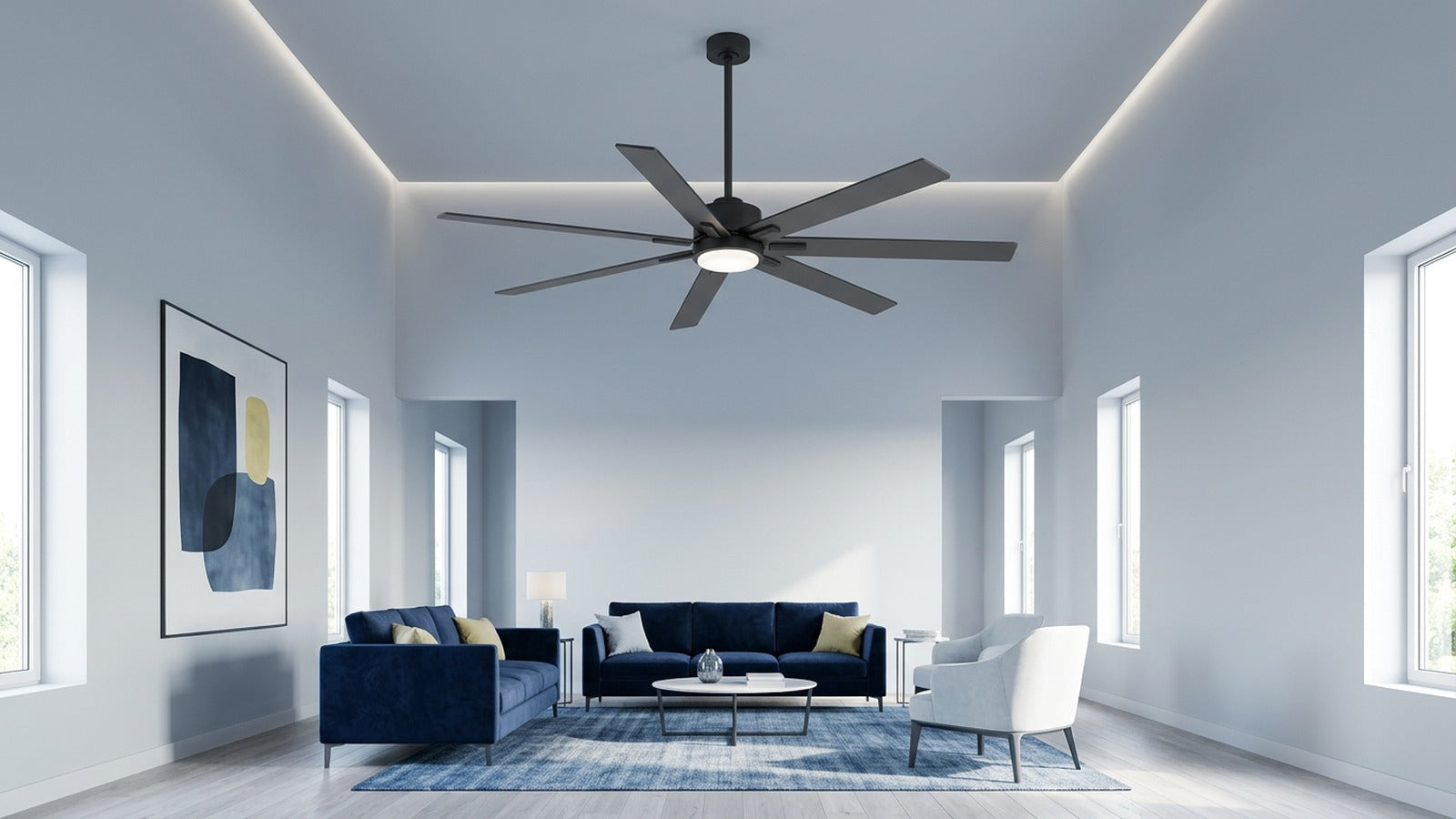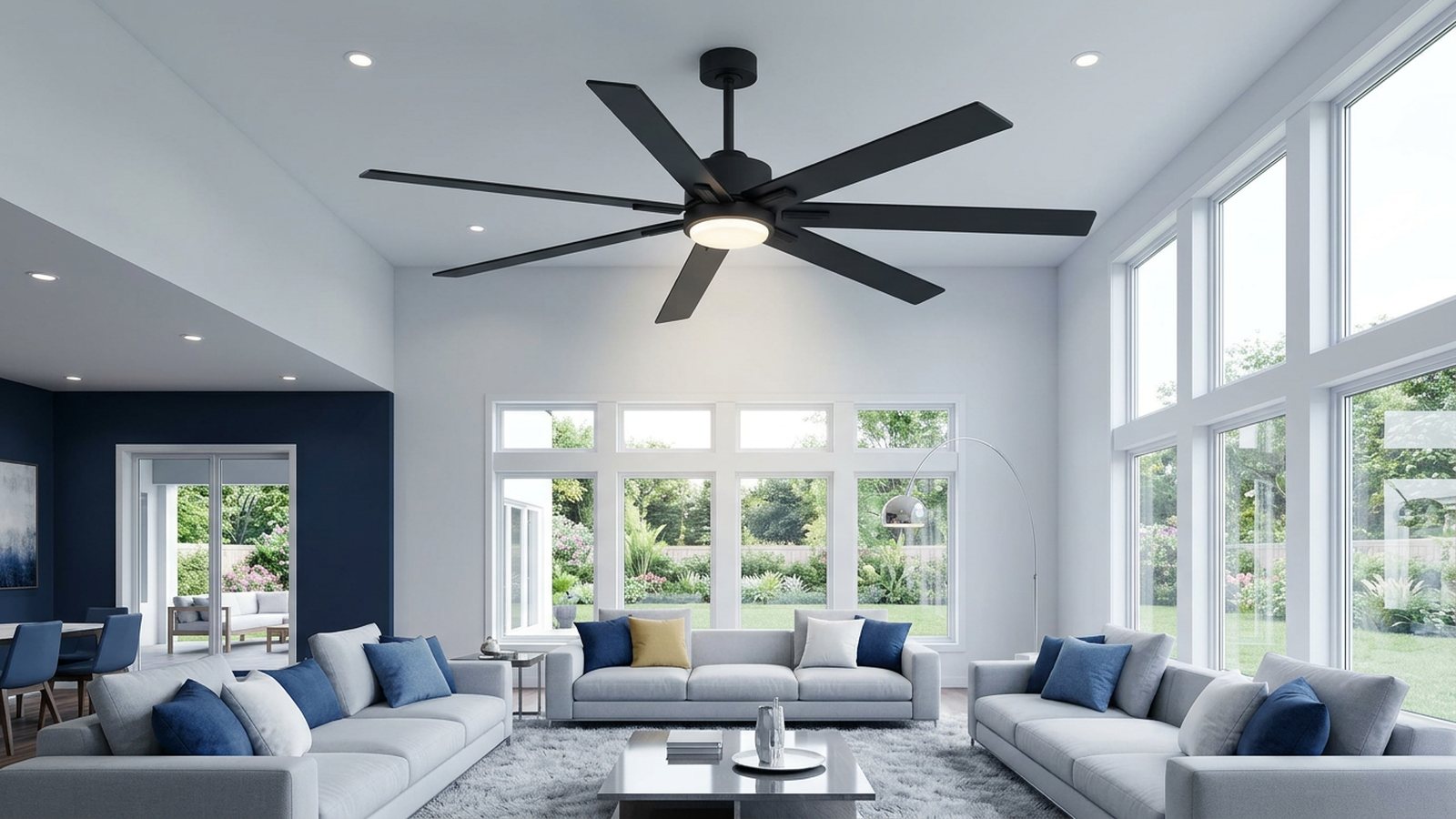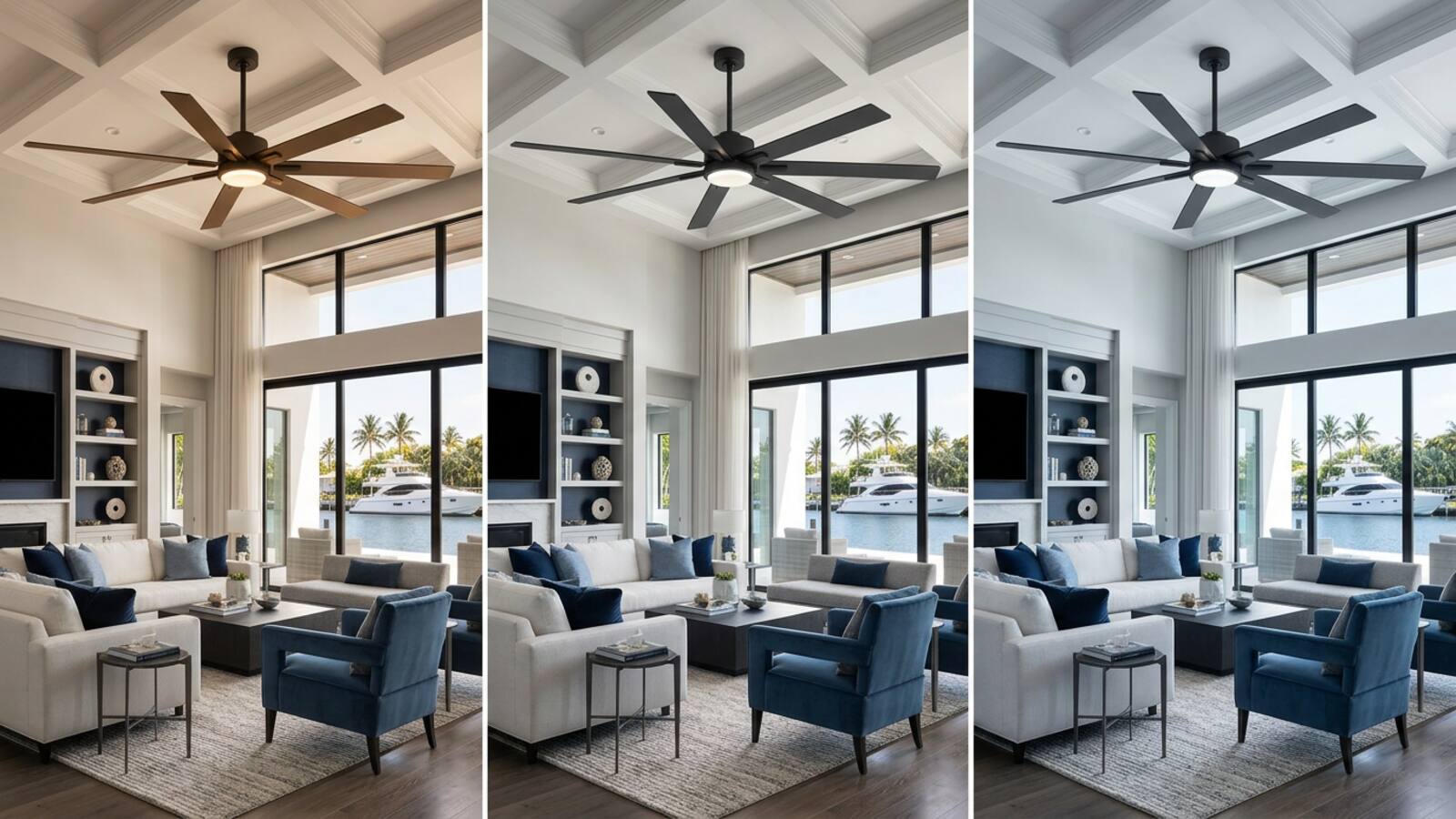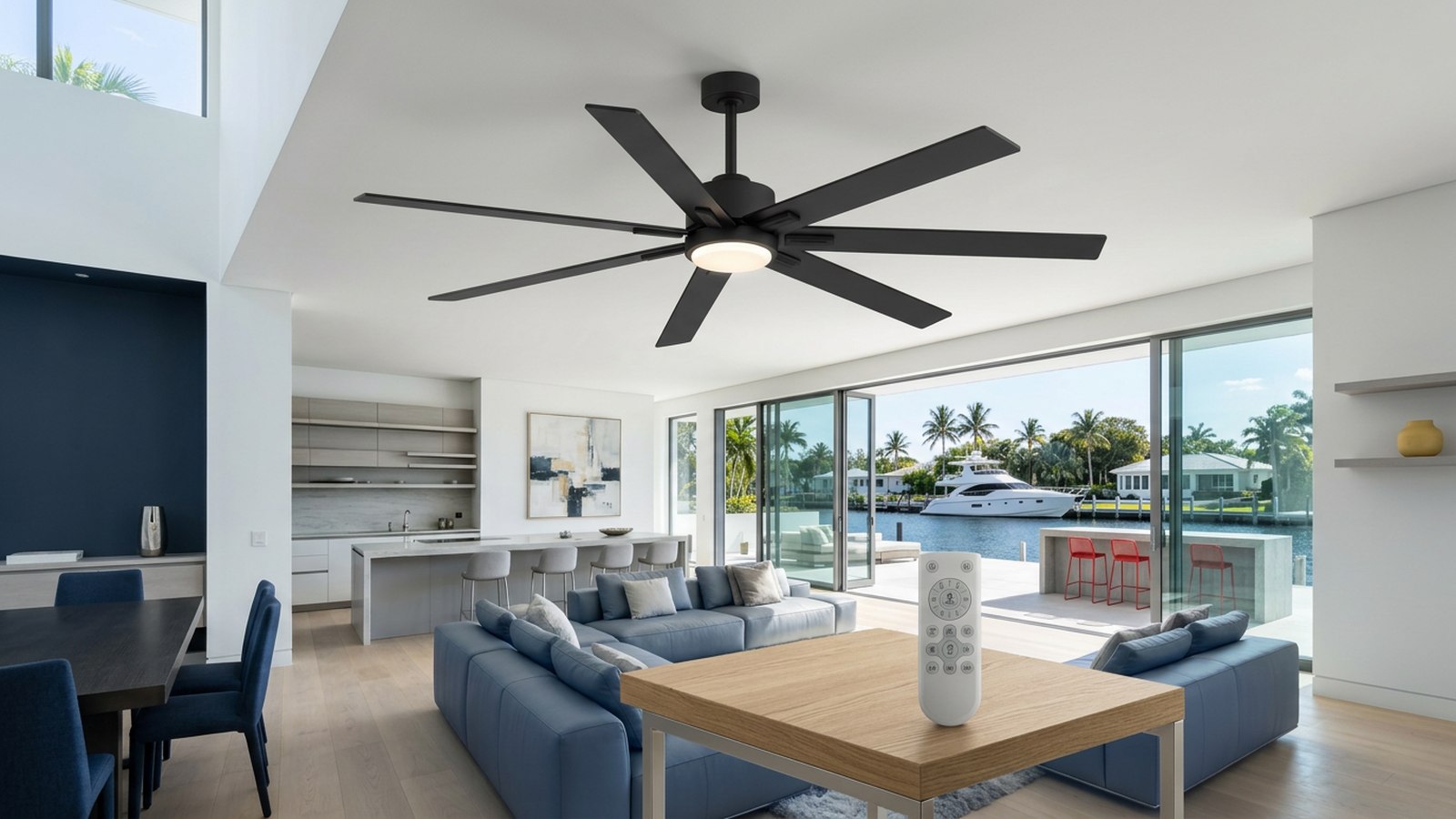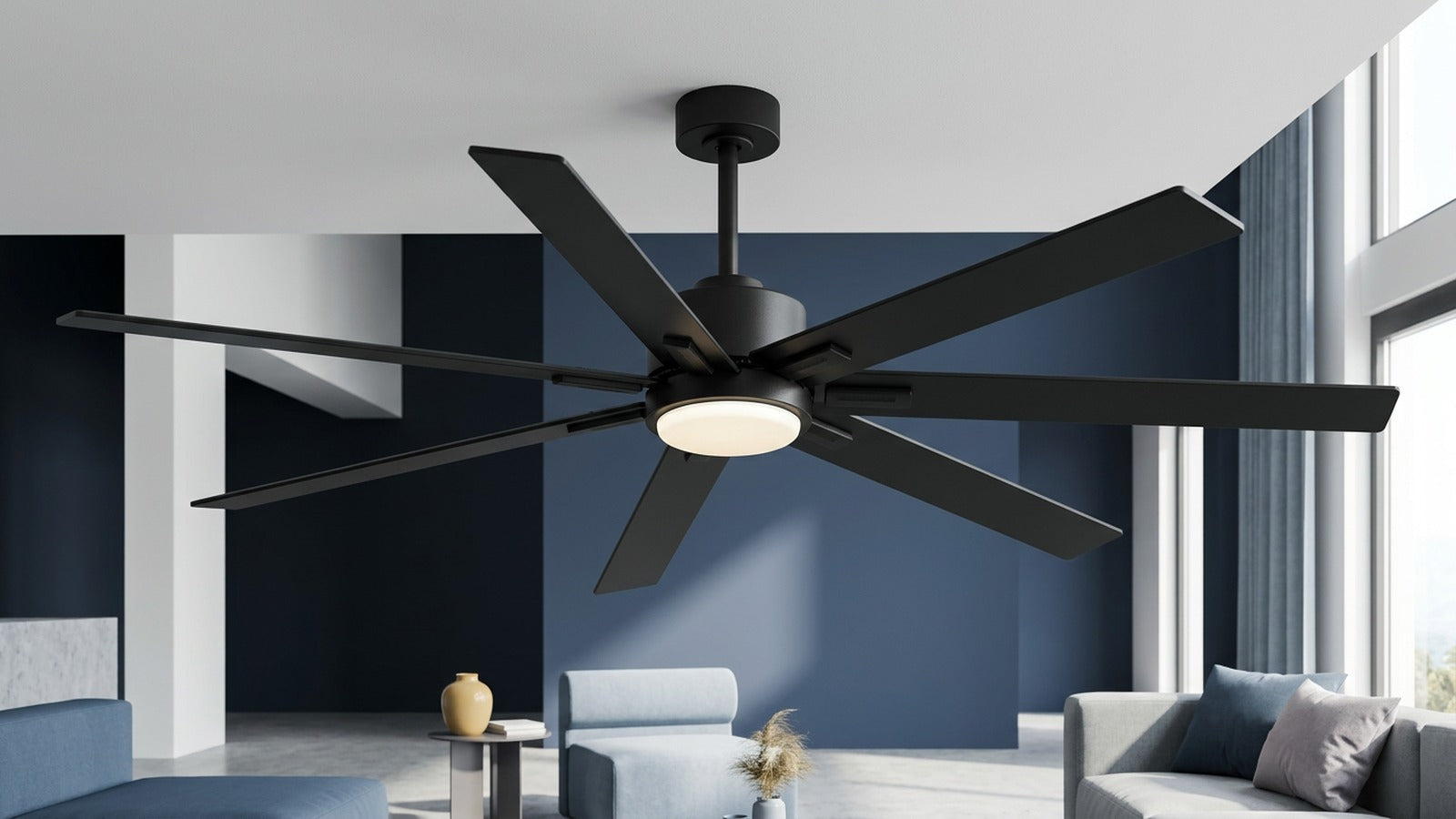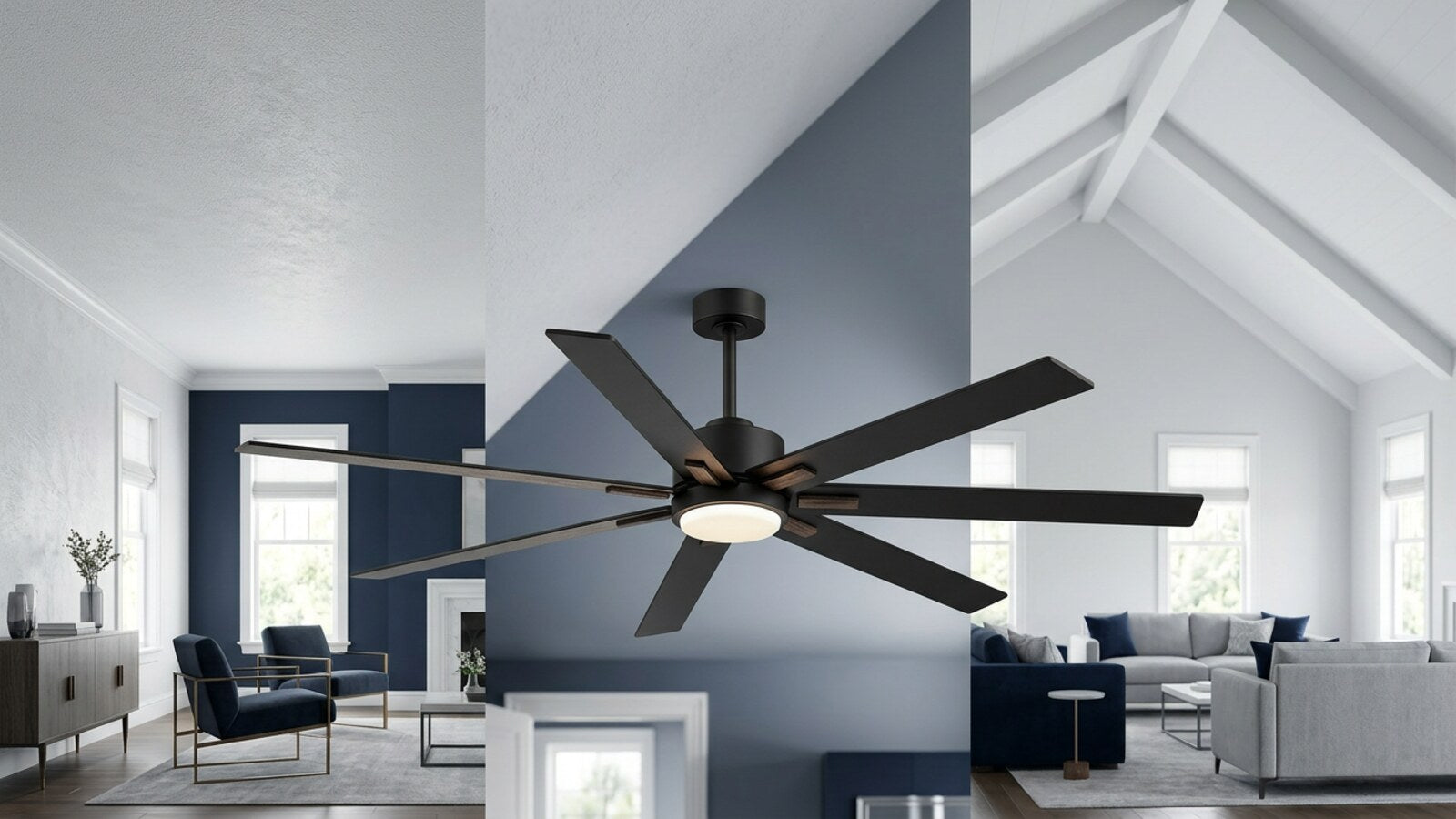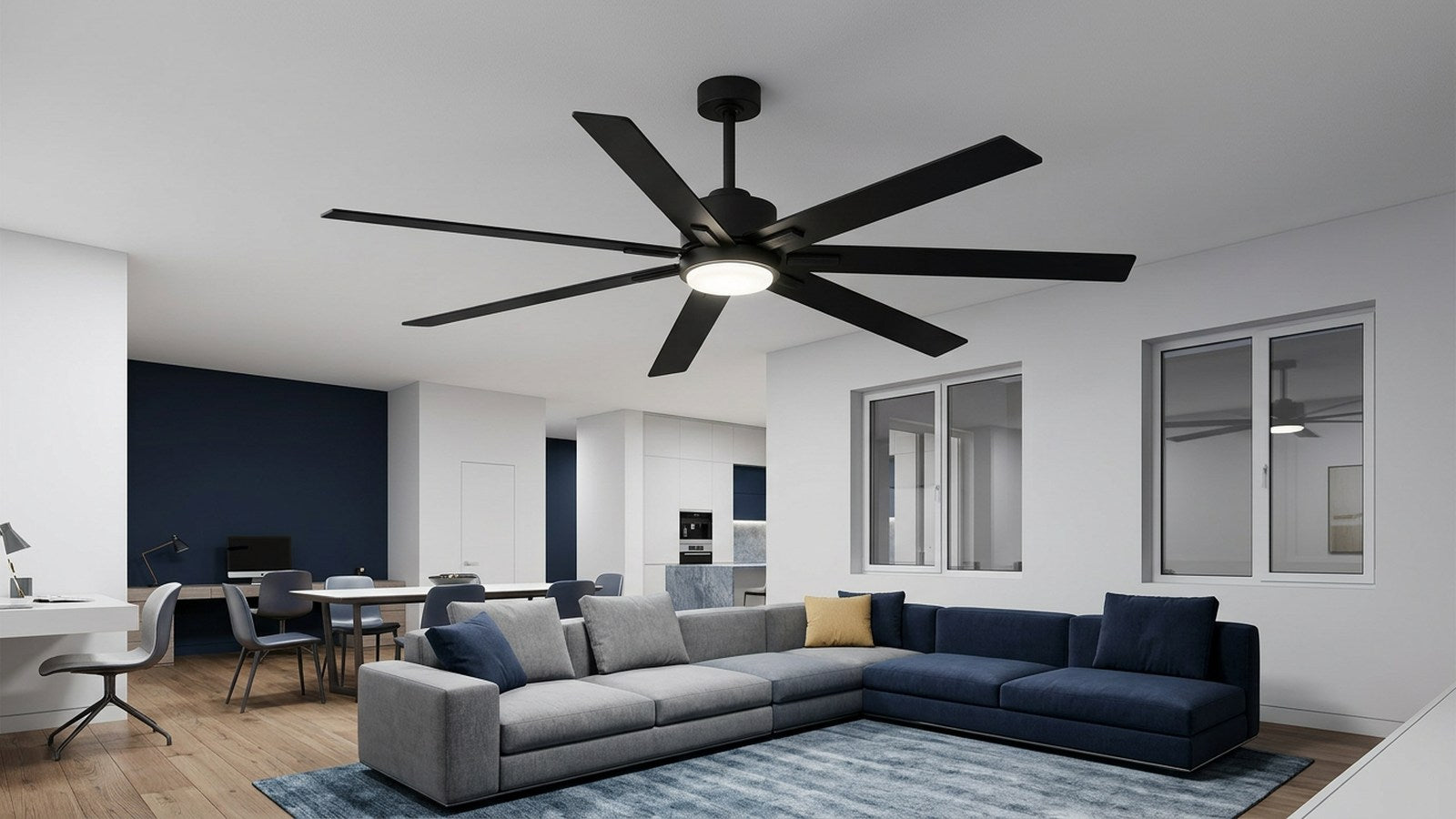
Large ceiling fan with an LED light installed in a high-ceiling living room

Large Ceiling Fans With Lights for High Ceilings

Choose factory-direct large ceiling fans with lights for high ceilings by comparing the actual room size, published airflow, installed height, downrod requirements and lighting functions. Breezary offers available models for single-unit online purchases and supports small-batch or multi-room discussions. Review fan diameter, CFM, LED lighting, dimming, color temperature, remote controls and ceiling compatibility before choosing a model. Product availability, included mounting components and verified functions should always be confirmed on the individual product page and model-specific instructions for the intended room, ceiling shape and installation conditions.

Available Lighted Models

Shop Large Ceiling Fans for High Ceilings With Lights

Browse current lighted models and open each product page to confirm the complete hanging dimensions, included downrods, light settings, control functions and mounting requirements. Compare only the specifications published for the individual model, then check current price, availability and delivery details before ordering.

Breezary 42004 large ceiling fan with light in a measured high-ceiling room

High-Ceiling Selection Process

How to Choose a Large Ceiling Fan With Light for a High Ceiling

Choosing large ceiling fans with lights for high ceilings starts with the room, ceiling and intended lighting role. Use the following eight checks to narrow the available models before comparing finishes, blade counts or current prices.

Room Dimensions

Measure the room’s length and width rather than relying on labels such as “large room” or “great room.”

Usable Floor Area

Identify the occupied and open areas that need airflow, especially when one room connects to another.

Finished Ceiling Height

Measure from the finished floor to the actual mounting point before considering the Downrod or complete hanging depth.

Ceiling Shape

Confirm whether the mounting surface is flat, sloped or vaulted. Ceiling shape can change the required mounting hardware.

Fan Diameter

Compare the complete blade span with the room proportions, mounting position and required clearances.

Published CFM

Use published airflow as a comparison point where the manufacturer provides it. Do not estimate CFM from diameter alone.

Lighting Role

Decide whether the fan light will provide primary, supplemental or ambient illumination in the space.

Control and Maintenance Access

Check how the fan speed and light are controlled and how the light source can be accessed after installation.

Information to Prepare for a Small-Batch Discussion

Providing the following details helps narrow the suitable models without assuming that every high-ceiling room needs the same fan.

  • Room length and width
  • Approximate square footage
  • Exact ceiling height
  • Flat, sloped or vaulted ceiling
  • Preferred fan size
  • Preferred finish
  • Lighting requirement
  • Control preference
  • Required quantity
  • Delivery destination
  • Project schedule

Start with the room and ceiling—not a preferred blade count, finish or price.

Large high-ceiling room layout with a Breezary 42004 ceiling fan and light

Size and Airflow

What Size Ceiling Fan Works for a Large Room With a High Ceiling?

There is no single diameter that fits every tall room. A useful comparison considers usable floor area, room shape, fan position, published airflow and final installed height together.

Measure the Usable Room Area

Record the room’s length and width, but also look at how the space is used. An open-plan room may contain a seating area, dining area, walkway and double-height section even though it appears to be one large rectangle on a floor plan.

Focus on the main occupied areas and determine whether a centrally located fan can serve them without interfering with walls, beams, tall cabinets or other ceiling fixtures.

Compare Fan Diameter and Published CFM

Fan diameter describes the overall blade span and helps indicate how much physical area the fan occupies. Published CFM describes the airflow reported for a specific model and operating condition.

A larger diameter does not automatically provide better airflow in every room. Motor design, blade geometry, operating speed and final mounting position also matter. The label extra large should therefore be treated as a size description—not a verified performance rating.

Do Not Choose by Blade Count Alone

A three-, four-, five-, six- or seven-blade fan cannot be ranked by blade count alone. The final airflow and operating characteristics depend on the complete fan design.

Blade shape
Blade pitch
Motor system
Rotation speed
Overall engineering
Published airflow

One Large Fan or Multiple Fans?

One large fan may suit a reasonably centralized room with one main activity zone. A long, divided or multi-zone great room may require a different layout, particularly when beams or architectural features interrupt the usable ceiling area.

One Large Fan May Suit

A centralized room, one main occupied zone and a suitable mounting position with adequate clearances.

Multiple Fans May Suit

Long rooms, separated activity areas, structural beams or spaces where one central position cannot serve the full layout.

Do not assume that one larger fan will automatically replace several properly positioned fans.

Breezary 42004 lighted ceiling fan showing installed height below a high ceiling

Mounting Height

Plan the Installed Fan Height and Downrod Configuration

When comparing large ceiling fans for high ceilings with lights, separate the ceiling height, Downrod length and complete hanging depth. These measurements describe different parts of the installation and should not be used interchangeably.

Measurement What It Means
Ceiling height The vertical distance from the finished floor to the ceiling or actual fan mounting point.
Downrod length The length of the Downrod component itself. It does not include every part positioned above and below the rod.
Complete hanging depth The combined vertical depth of the canopy, mounting assembly, Downrod, motor housing and light kit in the installed configuration.

Planning Formula

Approximate fan-bottom height
= finished ceiling height − complete installed hanging depth

  • A sloped-ceiling adapter or model-specific mounting component may change the final installed height.
  • The bottom of the light kit may extend lower than the blade plane and must be included when checking clearance.
  • Downrod length alone does not describe the fan’s complete vertical dimension.
  • A fan mounted too high may produce less noticeable air movement in the occupied area below.
  • A fan mounted too low may create clearance and safety concerns.
  • Confirm approved mounting components, model instructions and applicable local requirements before installation.

Model-specific check: do not assume that a Downrod, extension or angled adapter fits a fan because the finish or connection appears similar. Use only components approved for the specific model and installation.

Breezary 42004 ceiling fan light illuminating a large high-ceiling living room

Lighting From a Greater Height

Will a Ceiling Fan Light Be Bright Enough From a High Ceiling?

When comparing large ceiling fans with lights for high ceilings, the presence of an LED does not by itself confirm that the occupied area will receive enough useful light. Mounting height, published light output, diffusion and the room’s other light sources all affect the result.

Do Not Judge Brightness by LED Wattage Alone

Wattage describes electrical power use, not the complete lighting result in the room. Where available, compare published lumens together with the way the fixture directs and diffuses the light.

Published Lumens

Use the model’s published output where the manufacturer provides it.

Light Direction

Downward, diffused and surrounding light can create different visual effects.

Diffuser Design

The lens or shade affects glare, spread and the apparent softness of the light.

Mounting Distance

More distance between the light and occupied area can change perceived brightness.

Room Surfaces

Light walls and ceilings may reflect more light than dark, low-reflectance finishes.

Natural Light

Daylight conditions change throughout the day and do not replace night-time planning.

Existing Fixtures

Recessed, wall, floor and task lights may already serve part of the room.

Decide Whether It Is the Main or Supplemental Light

A fan light can combine air movement and illumination at one ceiling location, but its role should be established before a model is selected. Consider whether it needs to illuminate the complete room, support existing fixtures or provide softer ambient light.

A fan light mounted on a high ceiling should not automatically be treated as the room’s only light source.

Use Layered Lighting in Large High-Ceiling Rooms

A layered plan distributes different lighting functions across the room. The exact combination depends on the room layout and intended activities; it is not necessary to install every fixture type listed below.

Fan light

Recessed lighting

Wall lighting

Floor lamps

Task lighting

This section provides a fan-light selection framework and is not a complete architectural lighting design plan.

Breezary 42004 large ceiling fan demonstrating different LED color temperature settings

Light Functions and Maintenance

Compare LED Lighting, Color Temperature and Dimming

For large ceiling fans for high ceilings with lights, lighting flexibility should be compared with future maintenance access. Check the exact model for its light source, published output, supported color settings, dimming method and replacement procedure.

Integrated LED vs Replaceable Bulbs

Neither system is automatically better for every high-ceiling installation. Compare the verified functions and maintenance requirements of the individual model.

Lighting Option What to Verify
Integrated LED Published brightness where available, supported color temperature, dimming, LED-module access, replacement procedure and parts availability.
Replaceable bulbs Bulb-base specification, permitted bulb type, maximum wattage, bulb dimensions, dimming compatibility and safe access after installation.

Choose Color Temperature by Room Use

Color temperature affects how the room feels and how clearly objects and surfaces appear. Only advertise selectable CCT or multi-color lighting when the specific fan model supports it.

Warm Light

Often suited to relaxing living rooms, bedrooms and evening use where a softer atmosphere is preferred.

Neutral Light

Often suited to open living spaces and general daily activity where balanced illumination is useful.

Cooler Light

May suit task-oriented areas where clearer visual contrast is preferred, subject to the model’s supported settings.

Check Whether Dimming Is Actually Supported

A product described as having an LED light should not automatically be assumed dimmable. Verify the following functions on the individual product page and instructions.

  • Whether the light is dimmable
  • Available dimming range or levels
  • Remote-control or wall-control operation
  • Separate fan and light controls
  • Supported color-temperature settings
  • Whether settings remain after power interruption

Verified example: Breezary Item #42004 is a 72-inch, seven-blade model with a 3CCT dimmable light and remote control. Exact operating steps should still follow its model-specific product information and instructions.

Breezary 42004 high-ceiling fan with light operated by its model-specific remote control

Everyday Control

Control the Fan and Light Without Reaching the Ceiling

High-ceiling fans with lights and remote control can make routine operation more convenient, especially when the fan is mounted beyond comfortable physical reach. However, control functions vary by model and must be checked individually.

Function What to Verify Model Condition
Fan speed Number of available speeds and how they are selected. Where supported by the specific model.
Light on/off Whether the fan light can be operated separately from the fan. Where supported by the specific model.
Dimming Whether dimming is supported and how brightness is adjusted. Where supported by the specific model.
Color temperature Available CCT settings and the control sequence used to change them. Where supported by the specific model.
Timer Available timer periods and whether they control the fan, light or both. Where supported by the specific model.
Reversible operation Whether direction can be changed by remote or requires another model-specific method. Where supported by the specific model.
Memory Whether previous fan or lighting settings are restored after power is interrupted. Where supported by the specific model.
Wall-control compatibility Whether the fan supports a specified wall control and how it relates to the remote receiver. Where supported by the specific model.
Receiver location Where the receiver is installed and whether there is adequate space in the approved mounting assembly. Follow the specific model instructions.

Remote Access Does Not Replace Installation Planning

A remote control improves access, but it does not replace correct fan sizing, Downrod planning, mounting clearance or lighting design.

If the existing wall-switch arrangement, wiring or receiver location is unclear, follow the model-specific installation instructions and use a qualified electrician where required.

Breezary 42004 seven-blade ceiling fan with light in a high-ceiling room

Complete Fan Performance

Compare Motor Performance, Blade Design and Reversible Operation

When evaluating large ceiling fans with lights for high ceilings, do not use motor labels or blade count as shortcuts for overall performance. Compare the complete model, including published airflow, available speeds, blade geometry, controls and verified reversible operation.

Check the Motor Information Published for the Model

A motor description can help distinguish available fan designs, but it should not be treated as a complete performance claim. Compare the information actually published for the individual fan.

Available Speeds

Check the number of speed settings and how they are selected.

Published CFM

Use manufacturer-published airflow where it is available.

Noise Information

Use only model-specific noise information or verified testing.

Power Information

Compare published consumption data without estimating savings.

Reverse Function

Confirm whether reversible operation is provided and controlled.

Control Method

Verify remote, wall-control or other model-specific operation.

Do not automatically describe every DC-motor fan as whisper quiet, maintenance-free, Energy Star certified or more efficient without model-specific evidence.

Blade Count Is Not an Airflow Ranking

Three, four, five, six or seven blades do not create an automatic performance hierarchy. Airflow depends on the interaction of the motor, blade geometry, rotation speed and the overall design of the complete fan.

Blade shape
Blade pitch
Blade material
Motor system
Rotation speed
Published airflow

Compare the product’s published specifications rather than assuming that more blades—or fewer blades—will perform better in a tall room.

Confirm Reversible Operation by Model

Reversible operation can support different seasonal air-circulation strategies, but it does not replace a heating or cooling system. Confirm whether the specific fan supports reversal, how direction is changed and whether the fan must stop before the setting is changed.

Verified example: Breezary Item #42004 is a 72-inch, seven-blade model with six speeds, remote control and reversible operation. Follow its model-specific instructions for the actual operating method.

Breezary 42004 product reference beside flat sloped and vaulted ceiling profiles

Mounting-Surface Check

Check Flat, Sloped and Vaulted Ceiling Compatibility

Ceiling shape can change the mounting components, clearances and final hanging position required for a large lighted fan. A suitable diameter and Downrod do not by themselves confirm compatibility with an angled or vaulted surface.

Flat Ceilings

Confirm the fan-rated mounting point, complete hanging depth, receiver space, blade clearance and light-kit clearance.

Sloped Ceilings

Verify the model’s published slope limit, approved mounting hardware, canopy movement and any required angled adapter.

Vaulted Ceilings

Measure the actual mounting point and surrounding ceiling geometry, not only the room’s highest ridge or peak.

Confirm These Details Before Installation

  • Ceiling angle
  • Fan-rated outlet box
  • Mounting bracket
  • Canopy clearance
  • Required angled adapter
  • Published slope limit
  • Approved Downrod connection
  • Blade-to-ceiling clearance
  • Blade-to-wall clearance
  • Light-kit clearance
  • Remote receiver location
  • Complete installed height

A long Downrod does not by itself confirm that a fan is compatible with a sloped or vaulted ceiling.

Do not drill, modify or combine mounting parts unless the model-specific instructions explicitly approve the configuration. If the ceiling structure, wiring or wall-switch arrangement is unclear, use a qualified electrician where required.

Breezary 42004 large ceiling fan with light above an open high-ceiling living area

Room and Installation Context

Match the Fan and Light to the Space Below the High Ceiling

The right choice among large ceiling fans for high ceilings with lights depends on the occupied area beneath the fan. Room use affects lighting, controls, low-speed comfort, mounting position and whether one central fan can serve the complete layout.

Great Rooms and Open-Plan Spaces

Compare the complete open area, activity zones, furniture layout, architectural beams and available mounting positions.

A single centralized fan may not serve every separated part of a long or multi-zone room.

Large Living Rooms

Consider the seating area, television viewing, evening dimming, ceiling height and whether the fan light is primary or supplemental.

Large Living Room Ceiling Fans

High-Ceiling Bedrooms

Low-speed comfort, night-time lighting, remote access and verified noise information may matter more than maximum speed alone.

Large Bedroom Ceiling Fans

Unique and Decorative Interiors

The fan should relate to the room’s scale and materials without allowing appearance to override airflow, clearance or lighting requirements.

  • Modern
  • Black
  • Wood
  • Rustic
  • Farmhouse

Confirm the Correct Indoor or Outdoor Rating

A fan should not be assumed suitable for a covered or exposed outdoor location simply because its size, lighting and Downrod fit the space. Confirm the product’s stated location rating before installation.

Large Outdoor Ceiling Fans With Lights

Best Fit, Price and Purchase Options

Compare the Best Factory-Direct Fan for Your Actual Requirements

The best large ceiling fans with lights for high ceilings should be compared by verified room, installation, airflow and lighting requirements—not by price, diameter or blade count alone. The right choice is the model that fits the intended space and confirmed mounting conditions.

Comparison Point Why It Matters
Room dimensions Establishes the usable area and airflow coverage requirement.
Fan diameter Helps evaluate room proportion, placement and required clearance.
Published CFM Provides a manufacturer-published airflow comparison where available.
Complete hanging depth Helps estimate the final position of the blades and light kit.
Included Downrods Shows which mounting configurations are supplied with the model.
Lighting output Helps determine whether the light is primary, supplemental or ambient.
Dimming and CCT Indicates how the light can adapt to different activities and times.
Remote functions Affects the convenience of operating a fan mounted beyond easy reach.
Ceiling compatibility Determines whether the approved hardware fits the intended ceiling.
Warranty Defines the published coverage and model-specific warranty conditions.
Replacement parts Affects future light, remote and component maintenance.
Current price Establishes the present purchase cost without relying on outdated pricing.
Inventory Confirms whether the selected model can currently be ordered.
Shipping Affects final delivery cost, timing and project planning.

Product reviews should only reproduce or summarize genuine feedback already associated with the relevant product page. Do not describe a model as “best rated” without adequate, verifiable review data.

Single-Unit Purchase

Buy One Available Fan Online

Available models can be purchased individually through the standard Breezary Shopify checkout process. Open the specific product page before ordering to confirm the current configuration and published installation information.

  • Check the current product-page price
  • Confirm current availability
  • Review model-specific functions
  • Check shipping for the destination
  • Review installation requirements
Project Purchasing

Discuss a Small-Batch or Multi-Room Order

Breezary can discuss product selection and current purchasing requirements for projects involving several high-ceiling rooms or repeated installation conditions.

  • Multiple high-ceiling rooms
  • Whole-home renovation
  • Apartments
  • Hotels and lodging
  • Interior design projects
  • Residential developments
Model
Quantity
Finish
Lighting
Controls
Ceiling height
Downrod needs
Mounting needs
Destination
Availability
Schedule
Delivery

What Factory-Direct Support Means

Breezary supports factory-direct single-unit purchases and small-batch project discussions. Availability, configuration, price and delivery still depend on the selected model, quantity, destination and current production or inventory conditions.

  • Factory direct does not always mean the lowest price.
  • Do not assume every model can be customized.
  • Specified Downrod availability must be confirmed.
  • Project delivery dates must be confirmed before purchase.
  • Small-batch orders do not automatically receive wholesale pricing.
  • Mounting compatibility must be verified for the specific model.

Frequently Asked Questions

Large Ceiling Fans With Lights for High Ceilings FAQs

These answers provide a planning framework. Final fan size, hanging depth, lighting functions and ceiling compatibility must be confirmed from the individual product page and model-specific instructions.

What are the best ceiling fans for high ceilings with lighting?

The best choice is a model that matches the room dimensions, usable area, finished ceiling height and mounting conditions. Compare fan diameter, published CFM, complete hanging depth, lighting output, dimming, color temperature and controls. Also confirm the approved Downrod and ceiling compatibility. A model should not be called best simply because it is the largest, brightest or most expensive option.

What size ceiling fan is best for a large room with a high ceiling?

There is no universal fan diameter for every large high-ceiling room. Measure the room length, width, usable area and primary occupied zones, then compare suitable blade spans and published airflow. Final mounting height, walls, beams and the choice between one or multiple fans also matter. Use the individual model’s specifications instead of relying only on a general room-size chart.

Do ceiling fans work effectively with high ceilings?

They can work effectively when the fan size, airflow and final installation height suit the room. Mounting a fan too close to a very high ceiling may reduce noticeable air movement in the occupied area. The solution is not automatically the longest available Downrod. Calculate the complete hanging depth, maintain required clearances and follow the mounting configurations approved for the specific model.

How high is too high for a ceiling fan?

There is no single ceiling height at which every fan becomes ineffective. Performance depends on the room, fan diameter, published airflow and the distance between the blade plane and occupied area. Instead of using ceiling height alone, determine the actual mounting point and complete installed depth. If the proposed configuration falls outside the model instructions, consult the manufacturer or a qualified installer.

How low should a ceiling fan hang from a high ceiling?

The appropriate hanging position depends on the specific room, ceiling shape, fan design and applicable clearance requirements. Calculate the fan-bottom height by subtracting the complete installed hanging depth from the finished ceiling height. Include the canopy, Downrod, motor housing and light kit in that calculation. Do not use the Downrod length alone as the fan’s complete vertical dimension.

Do I need a longer Downrod for a high ceiling?

A high ceiling may require a longer approved Downrod, but the correct length cannot be selected from ceiling height alone. Consider the complete fan depth, intended blade height, light-kit position and required clearances. Sloped-ceiling hardware can also change the final position. Confirm that the selected Downrod and any coupler or adapter are approved for the exact model before installation.

What type of fan lighting is best for high ceilings?

The best lighting type depends on whether the fan light will be primary, supplemental or ambient. Compare published lumens where available, light direction, diffuser design, color temperature, dimming and future maintenance access. Integrated LEDs and replaceable bulbs each have different considerations. Neither is automatically better, so verify the actual functions and replacement procedure for the individual fan.

Can a ceiling fan light be the main light source in a high-ceiling room?

It may be possible in some rooms, but a fan light should not automatically be treated as the only light source. Greater mounting distance, room size, dark finishes and activity zones can affect perceived brightness. Compare published output and light distribution, then consider recessed lights, wall lights, floor lamps or task lighting where needed. The final plan should reflect how the room is actually used.

Are integrated LED fan lights difficult to replace?

Replacement difficulty varies by product. Some integrated LED modules are designed as model-specific service parts, while others may require a broader light-kit or component replacement. Before buying, confirm how the module is accessed, whether replacement parts are available and what the instructions allow. Maintenance access matters more when the fan is mounted high enough to require special equipment or professional assistance.

Should a high-ceiling fan have a remote control?

A remote control is often practical because it allows operation without reaching a high-mounted fan. Depending on the model, it may control speed, lighting, dimming, color temperature, timer or reversal. Confirm every function individually and check the receiver location and wall-switch arrangement. A remote improves access, but it does not replace correct fan sizing, Downrod planning or mounting clearance.

Is a four-blade or five-blade ceiling fan better for a high ceiling?

Neither blade count is automatically better. Airflow and operating characteristics depend on blade shape, pitch, material, motor design, rotation speed and the engineering of the complete fan. Compare published CFM and other verified specifications for the individual models. Choosing by blade count alone can overlook more important factors such as diameter, mounting height, noise information, lighting and control functions.

Can a large ceiling fan with light be installed on a vaulted ceiling?

Only when the specific fan and approved mounting system support the ceiling angle and installation conditions. Verify the published slope limit, mounting bracket, canopy clearance, required adapter, approved Downrod and blade clearances. A long Downrod does not by itself confirm vaulted-ceiling compatibility. Do not modify mounting parts unless the model instructions expressly allow it, and use a qualified electrician where required.